IB Board Vs CBSE: Understanding the Difference

February 22, 2026
Table of contents
Deciding which school board to select for your child will be an important factor in their educational career. When considering all of your options, parents typically take the time to compare each choice for their child based on various factors such as: Learning Styles, Teaching Curriculum - Depth of Curriculum, Assessments, and Outcomes.
This Guide will explain the differences between IB vs CBSE School Boards, allowing you to make an informed decision based on your child's specific learning requirements and, therefore, your child's future success.
What Does Each Board Mean?
To accurately compare IB to CBSE, it's essential that you first understand the difference between IB and CBSE.
- CBSE (Central Board of Secondary Education): A national Indian board that provides a standardized curriculum across states, preparing students at every stage of their education through a structured, exam-focused academic framework, with schools affiliated across India and abroad.
- IB (International Baccalaureate): A standardized board operates as an internationally recognized curriculum, focusing on the inquiry process, concepts, and skills - allowing students to make real-life connections between themselves and other students whom they have not met through school or otherwise.
When parents look at CBSE vs ICSE vs IB, CBSE is often chosen for consistency and exam readiness, while IB is chosen for its global outlook and skills-based learning.
Also Read- IB vs CBSE vs IGCSE: Which Study Board Is Right for You?
How Do Teaching Approaches Differ?
The two education systems can be contrasted by their different paths to achieving knowledge. The IB board vs CBSE comparison focuses on the mastery of facts.
- CBSE Teaching Approach: Teaching through direction by the teacher for the specific goals of each subject. Utilising standardised resources such as textbooks and scheduled classes. And focusing on developing a good base in maths, science, and language skills.
- IB Teaching Approach: Learning happens through student inquiry and discussion guided by teachers. It connects different subjects and helps students develop critical thinking, reflection, and strong communication skills.
Curriculum Structure: What Will Your Child Learn?
Understanding the IB board syllabus and what the CBSE syllabus means helps parents assess daily learning.
Aspect | IB Board | CBSE Board |
| Curriculum design | Concept-based, inquiry-driven | Structured, subject-focused |
| Learning style | Project work, discussions, and reflections | Textbooks, exercises, and classroom teaching |
| Subject integration | Strong cross-curricular links | Subjects are taught mostly independently |
| Global perspective | Core focus of learning | Limited global exposure |
| Curriculum Flexibility | High- students can choose subjects and learning pathways | Moderate- fixed curriculum with limited subject choices |
The IB board syllabus is built to develop thinking skills alongside content knowledge. In contrast, the CBSE syllabus means a well-defined path of topics and learning outcomes across grades.
This is why many families weighing CBSE vs ICSE vs IB note that IB offers broader skill development, while CBSE offers a predictable academic route.
How Are Students Assessed?
Another distinction between IB and CBSE is the method of assessment.
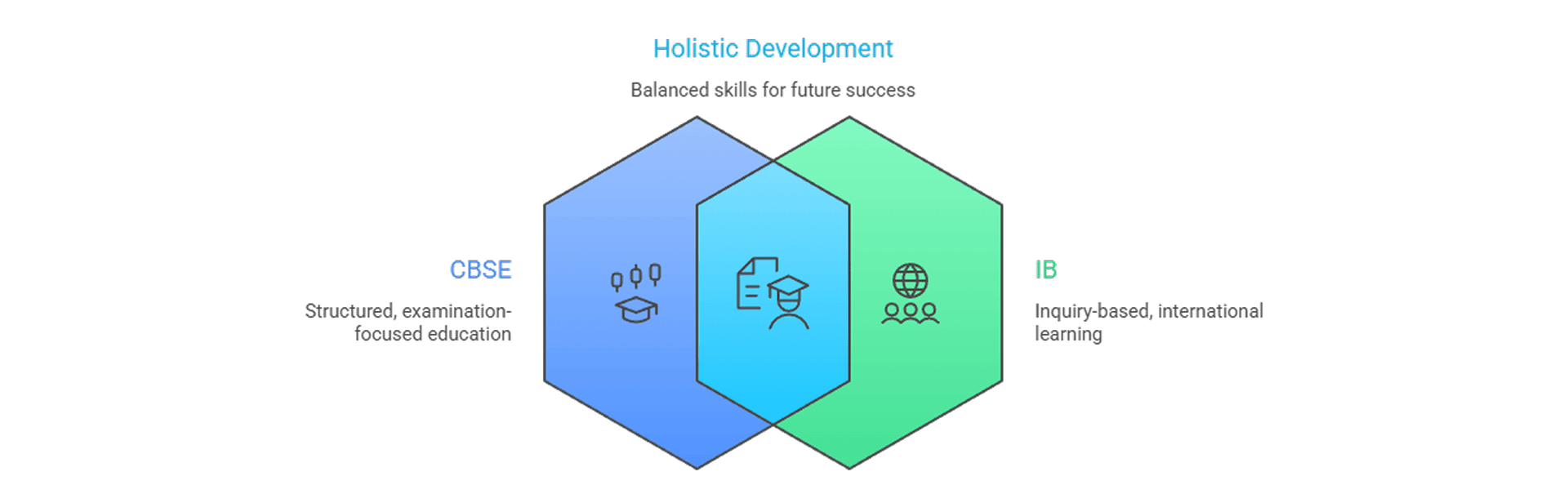
- CBSE Assessment: The student assessment process includes frequent testing throughout the school year, as well as final exams; a primary means of evaluating student performance is by way of the written assessments completed and measured by established grading standards.
- IB Assessment: Combination of projects, presentations, reflections, and tests. Assessments throughout the course, along with final exams. The learning process and resulting outcomes have equal importance. The application of concepts will also be part of the learning process.
In comparing families against IB vs CBSE, CBSE tends to favour children who excel in testing and scheduled evaluations, whereas IB is suited to children who show their knowledge through various means.
What Is the Student Experience Like?
When comparing CBSE to IB, the daily school life is very different.
CBSE Student Experience:
- Set a schedule of subject periods.
- Structured and defined progression in the syllabus.
- Assignments focused on practice/skills.
IB Student Experience:
- Learning through projects.
- Collaborative, group discussion, and independent research.
- Focus on communication/collaboration.
- Reflection/learning-related to learn.
Many parents often say that IB students learn how to be articulate, problem-solve, and think independently much sooner than students of the CBSE. In addition to this, students who attend the CBSE generally exhibit a greater level of academic commitment and preparation for examinations.
How to Choose Between IB and CBSE?
There is no one definitive or best answer to the IB vs CBSE question. The decision depends on what the family believes is most important to them and their child.
Choose CBSE if:
- You are interested in a primarily structured, examination-based system.
- You want opportunities for your child to thrive with consistent routines and markers.
- You are planning for competitive exams in the future for your child. You want many schools throughout India.
Choose IB if:
- You are looking for an international perspective on the curriculum.
- You want your child to learn through questioning, inquiry, and exploration.
- You value research skills, communication skills, and critical thinking.
- You may also consider pursuing higher education outside of the country.
Families tend to make comparisons when considering an IB board or the CBSE board based on learning style rather than the reputation of each board. The difference between IB and CBSE becomes more meaningful when matched to the child’s personality.
Where Does IB EYP Fit for Younger Learners?
For early learners, the foundation matters. The IB Early Years Programme (EYP) plays an important part in supporting early school experiences with the IB curriculum.
IB EYP focuses on:
- Learning through play and inquiry.
- Exploring what you can find when you learn another language.
- Developing a greater understanding of others through social interaction.
- Encouragement to explore individual interests and develop independence from others.
The IB Early Years Programme facilitates student’s development. Children learn how to ask questions, explore themes, and reflect on experiences from an early age.
When comparing preschool programs such as CBSE, ICSE, and IB, parents frequently choose the IB Early Years Programme because the program fosters the development of confidence and learning habits. In addition, the transition to the IB board’s curriculum in subsequent grades is facilitated by the development of these skills through the IB Early Years Programme.
Comparison IB VS CBSE:
- Teaching style: Inquiry vs structured instruction.
- Assessments: Continuous + projects vs exam-focused.
- Curriculum: Concept-based vs content-driven.
- Skills focus: Thinking and communication vs academic mastery.
- Global exposure: Strong vs limited.
IB’s learning approach is built around inquiry. The IB’s own research pages emphasize integrating inquiry-based teaching and learning across programmes and subjects, which is why IB classrooms typically lean toward questioning, investigation, and conceptual understanding rather than only content coverage
CBSE’s curriculum documents explicitly push beyond rote learning. CBSE’s official curriculum notes that it aims for holistic development and emphasizes constructivist rather than rote learning, highlighting hands-on experience. This supports your point that CBSE is structured, but not meant to be “memorisation-only” in intent.
This quick view of the IB board vs CBSE helps parents make a balanced choice without overcomplicating the decision.
Final Takeaway for Parents
Focus on your child’s learning style rather than just that IB is identified as independent from other boards, or that CBSE may be structured in nature. Furthermore, both IB and CBSE offer differing ways of assessing, as well as differing levels of preparedness regarding real-world challenges. Lastly, for those looking for an inquiry-based method to help your child’s academic achievement from 0-6, then IB is an excellent choice.
References-