IB vs A Levels: How to Choose the Right Curriculum for Your Future

March 10, 2026
Table of contents
Students plan their futures because they understand that their choice of academic track will determine who they will become during high school. Families today look to find the academic environment best suited to their child by evaluating their skills, future goals, and preferred method of learning through the lens of an international curriculum. The discussion typically centres on IB and A-Levels, which serve as international academic systems that students from multiple countries study. The two learning methods provide college admission pathways to students, yet they differ because of their distinct teaching methods and organisational structures.
Understanding the IB Board Curriculum
The International Baccalaureate Diploma Programme (IBDP) is an internationally recognised academic programme designed for students aged 16–19. The IB board curriculum develops students through its balanced structure, which combines academic depth with critical thinking and real-world awareness. The IB board curriculum uses inquiry-based learning as its primary educational method because traditional systems evaluate students through their examination results. Students develop research skills, together with communication abilities and analytical skills, through their work in various academic fields. The IB board curriculum uses its holistic framework to evaluate student performance. Students study six subjects from different academic groups while also completing three core components:

- Theory of Knowledge (TOK) – encourages students to question how knowledge is formed
- Extended Essay (EE) – an independent research project of approximately 4,000 words
- Creativity, Activity, Service (CAS) – community engagement and personal development
Also Read- What is the International Baccalaureate (IB) Programme? A Complete Guide
What Subjects Do Students Study in the IB Programme?
The IB programme's main feature is the wide range of learning opportunities it offers. The IB board courses are divided into the 6 groups. These groups help students learn specialised skills and improve their ability to work with people from different fields.
The typical IB board subjects include:
- Language and Literature
- Language Acquisition
- Individuals and Societies (such as Economics, History, Psychology)
- Sciences (Biology, Chemistry, Physics)
- Mathematics
- The Arts
Students choose one option from each group, which enables them to achieve a balanced academic profile through their IB board subjects. Three subjects are studied at Higher Level, while the remaining subjects are taken at Standard Level. The flexibility to pursue each subject at either Higher Level (HL) or Standard Level (SL) allows students to align their academic choices with their strengths, interests, and future goals, building a strong foundation for success in higher education.
The broad IB board subject approach provides students with flexible academic options for their future studies. A student who wants to study engineering can develop essential communication skills through languages and humanities courses.
What Are A-Levels?
The British education system includes Advanced Level qualifications, which are commonly known as A-Levels and which universities worldwide recognise. Students can choose from more than 50 subject options in Cambridge International A-Levels and over 80 subjects across the broader UK A-Level system, depending on the exam board and school. The standard requirement for admission to many universities states that students need to study three to four A-Level subjects. The subjects which students need to complete their university requirements are selected by them. A student who plans to study medicine will select Biology, Chemistry and Mathematics as his or her required courses.
The A-Level system enables students at the A-Level system to concentrate on specific subjects, while the IB board curriculum requires students to study multiple academic disciplines. The IB programme develops students through interdisciplinary studies, whereas A-Levels require students to concentrate on one subject for extensive research. The IB and A-Levels debate continues because both educational systems present students with different approaches to learning and academic content that prepare them for university studies.
IB vs A-Levels: Key Differences
Aspect | IB (International Baccalaureate) | A-Levels |
| Subject Structure | Students study six subjects across multiple disciplines along with core components like Theory of Knowledge (TOK), Extended Essay, and CAS. | Students typically choose 3–4 subjects that align closely with their intended university specialisation. |
| Learning Approach | Focuses on inquiry-based learning, independent research, and critical thinking. Studies show 94% of university admissions officers believe IB encourages independent inquiry. | Emphasises deep subject mastery and exam performance. Around 49% of admissions officers believe A-Levels encourage independent inquiry. |
| Global Perspective | Designed to develop international awareness and global thinking. Surveys show 97% of admissions officers believe IB builds a global perspective effectively. | Primarily subject-focused and does not formally include a global perspective component in the curriculum. |
| University Preparation | Research indicates IB students are 57% more likely to attend elite universities, reflecting strong preparation for higher education. | A-Levels provide strong subject specialisation, which can be beneficial for students with clearly defined academic paths. |
Related blog- IB vs CBSE vs IGCSE: Which Study Board Is Right for You?
IB vs A-Levels: Pros and Cons
When comparing the International Baccalaureate (IB) and A‑Levels, parents often look at how each curriculum supports academic depth, skill development, and university readiness. Both programmes are globally recognised but differ in structure and learning approach.
Pros of the IB Curriculum
- Broad Academic Exposure
Students study six subjects across different disciplines, helping them build a well-rounded academic foundation.
- Research and Critical Thinking Skills
The Extended Essay and Theory of Knowledge components encourage independent research and analytical thinking.
- Holistic Development
Activities under Creativity, Activity, Service (CAS) support leadership, collaboration, and community engagement.
Cons of the IB Curriculum
- Heavy Workload
Managing six subjects along with core components can make the programme academically demanding.
- Less Subject Specialisation
Students may not be able to focus deeply on a few subjects because of the broader curriculum.
Pros of A-Levels
- Greater Subject Focus
Students usually choose three to four subjects, allowing deeper study in their chosen academic areas.
- Clear Academic Direction
The specialised approach can benefit students who already know the field they want to pursue in university.
Cons of A-Levels
- Limited Subject Range
Studying fewer subjects may reduce exposure to different academic disciplines.
- Exam-Focused Assessment
Final exams play a significant role in evaluation, which may create pressure for some students.
A Thoughtful Approach to International Education
Students must examine their academic interests, their learning preferences, and their future aspirations before they select between the International Baccalaureate and A-Levels. The International Baccalaureate program delivers a comprehensive educational experience that helps students develop their research skills, their global knowledge, and their personal development. A student requires three elements of educational experience, which include school teaching methods, teacher guidance, the learning environment, and basic educational principles of the school to achieve proper educational functioning.
Also Read- Developing Leadership Qualities Early: A Guide for Students
Factors to Consider When Choosing Between A-Levels and IB
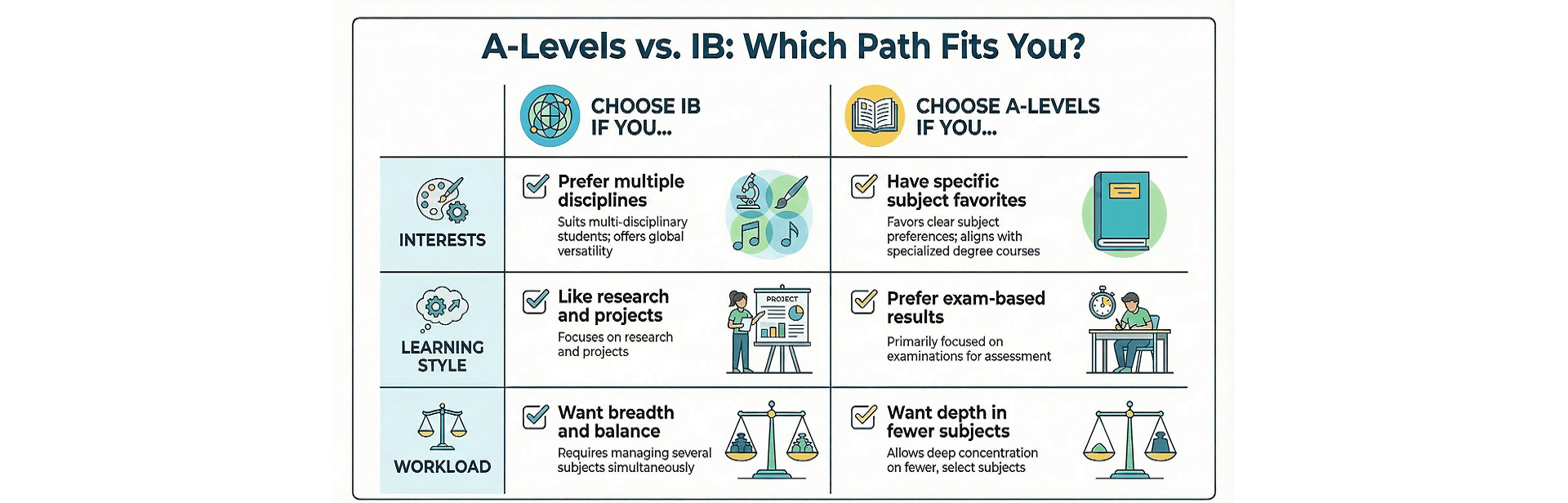
- Academic Interests
Students who prefer studying multiple disciplines may benefit from IB, while those with clear subject preferences may find A-Levels more suitable. - Learning Style
IB emphasises research, projects, and continuous assessment, whereas A-Levels are more exam-focused. - University Goals
Both programmes are widely accepted by global universities, but some courses may align better with the specialised structure of A-Levels. - Workload and Balance
IB involves managing several subjects along with core components, while A-Levels allow students to concentrate on fewer subjects with greater depth.
Conclusion
A student’s educational goals determine which learning environment better supports their needs when choosing between International Baccalaureate and A-Level programs. Students who prefer specialisation and deep academic focus may find A-Levels suitable.
The IB board curriculum structure benefits students who excel in studying multiple subjects at the same time in terms of their academic performance. The programme offers three main benefits, which include its IB board subjects and research focus, and its worldwide recognition of its academic programs.
The curriculum provides students with essential abilities that they will use in their future work beyond their classroom studies.
The families should study all the different aspects of IB and A-Levels because they want to discover international educational opportunities. This process will help them identify the best educational path for their children and support the development of their academic abilities.
References-
FAQ's
Many universities worldwide accept both A-level and IB pathways; however, the education pathway that is more commonly recognised internationally through university acceptance is probably IB, since its curriculum emphasises research skills, critical thinking, and interdisciplinary studies.
Typically, students take six subjects within different subject areas, plus one of each of the three core components of the IB Diploma Programme (Theory of Knowledge, Extended Essay, and CAS).
Yes, universities in India and around the world (including the United Kingdom, the United States, Europe, and many other countries) recognise the IB Diploma and its programmes.
Students with strong analytical thinking skills or a passion for doing research or studying a variety of subjects will do very well in the IB Programme.
Yes, the IB Programme is an academically challenging programme; however, it also provides students with skills in time management, independent research, and a global perspective.