What is the International Baccalaureate (IB) Programme? A Complete Guide

May 29, 2025
Table of contents
What is IB Board and Why Does It Matter?
To understand the value of the education we offer, it’s important to first understand what is IB board and how it differs from other boards.
The IB board, short for International Baccalaureate, is a globally recognized education system that originated in Geneva, Switzerland, in 1968. Designed to meet the needs of internationally mobile families, it now serves over 1.95 million students across more than 5,500 schools in 160 countries, including India. Unlike traditional boards that emphasize rote learning or textbook-based assessments, the IB board is inquiry-driven, concept-based, and interdisciplinary.
Parents often ask, What is International Baccalaureate, and how will it benefit my child? The answer lies in its learner-centric philosophy: the IB encourages students to ask questions, make connections, and become independent thinkers. It doesn’t just focus on the what - it asks why, how, and what's next?
A Deep Dive into What is IB Curriculum
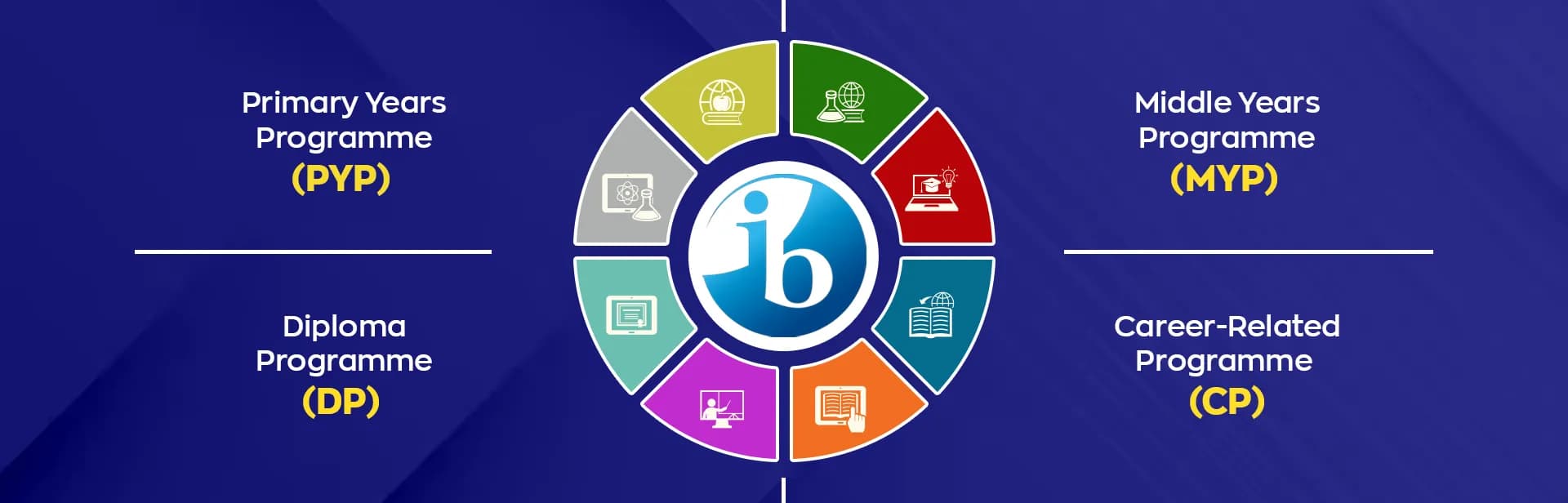
Let’s explore what is IB curriculum in detail, because this is where the true strength of the IB lies. Whether it’s the Primary Years Programme (PYP), the Middle Years Programme (MYP), or the Diploma Programme (DP), the IB curriculum is designed to cater to different stages of a student’s learning journey.
Each IB programme is based on a consistent philosophy and set of principles, fostering international-mindedness, cultural awareness, and a deep love of learning.
The 4 IB Programmes at a Glance
The IB curriculum is delivered across four programmes that span ages 3 to 19. A child can enter the IB at any stage, though most Indian families join at one of three points: nursery into EYP, Grade 1 into PYP, or Grade 11 into the Diploma Programme. Here is what each programme covers, in short.
1. Early Years Programme (EYP) - Ages 3 to 6 The EYP nurtures children through their earliest school years with play-based, inquiry-led learning. The focus is social-emotional development, language foundations, motor skills, and curiosity about the world. Children learn through structured exploration, storytelling and group activities rather than through textbooks.
2. Primary Years Programme (PYP) - Grade 1 to 5, Ages 6 to 11 The PYP builds academic foundations through six transdisciplinary themes that connect subjects rather than teach them in silos. Children explore who they are, where they are in place and time, how the world works, and how communities organise themselves. The emphasis stays on inquiry, language fluency, and learning how to learn.
3. Middle Years Programme (MYP) - Grade 6 to 10, Ages 11 to 16 The MYP bridges primary school and the senior years through eight subject groups studied alongside a Personal Project in Grade 10. Students develop critical thinking, research skills, and the intercultural awareness needed for the Diploma Programme. Assessment is continuous and project-based rather than dependent on a single year-end board exam.
4. Diploma Programme (DP)- Grade 11 and 12, Ages 16 to 19 The DP is the IB's flagship two-year pre-university qualification, recognised by every major university worldwide and by the Association of Indian Universities. Students take six subjects (three at Higher Level, three at Standard Level) plus three core components: Theory of Knowledge, the Extended Essay, and Creativity-Activity-Service.
At HUS, all four programmes run as a continuum on a single campus, which means a child can begin at age three and complete the full IB journey through to the Diploma without ever changing schools.
Key Components of the IB Curriculum
1. Subject Groups:
The curriculum is not confined to one discipline. It’s structured across six interconnected subject areas:
- Language and Literature
- Language Acquisition
- Individuals and Societies
- Sciences
- Mathematics
- The Arts
2. Core Elements (specific to the IB Diploma Programme):
- Theory of Knowledge (TOK): Encourages students to reflect on the nature of knowledge and how we come to know what we claim to know.
- Extended Essay (EE): A self-directed 4,000-word research project that hones independent research and academic writing skills.
- Creativity, Activity, Service (CAS): Ensures students engage in a variety of real-world projects and experiences, going beyond academics.
The purpose of the IB curriculum is not to overload students, but to broaden their horizons - to help them grow intellectually, ethically, emotionally, and physically.
So if you’re wondering what is IB curriculum and how it shapes a child’s future, the answer is: it’s an immersive journey that teaches students to apply what they learn to real-life scenarios.
Why Is the IB Programme So Respected Worldwide?
Understanding what is IB board goes hand-in-hand with understanding why it’s valued globally. Leading universities - including those in the US, UK, Australia, and Singapore - recognize and respect the IB’s academic rigor. IB graduates often have higher acceptance rates, are more likely to complete their degrees on time, and excel in multidisciplinary settings.
Because the curriculum emphasizes research, analysis, and writing skills that are crucial for university success, the IB becomes a strong foundation for any career path. Whether a student wishes to pursue science, law, the arts, or business, the IB creates the mindset and work ethic needed to succeed.
The Hiranandani Upscale School Experience: A Local Home for Global Education
In Chennai, Hiranandani Upscale School (HUS) has carved a niche for offering a truly global education grounded in an Indian ethos. With a sprawling green campus and a community of dedicated educators, HUS delivers the full IB continuum - PYP, MYP, and DP - under one roof.
But our commitment goes beyond just implementing the IB framework. We make it meaningful.
Our faculty undergoes regular training from the International Baccalaureate Organisation to ensure that their teaching remains current and impactful. The campus is equipped with purpose-built facilities for science, arts, sports, and community engagement. Students at HUS don’t just learn - they lead, collaborate, and contribute.
And because we're in Chennai, we bring global standards into a culturally rooted, safe, and familiar setting for your child.
How Does the IB Curriculum Support Every Kind of Learner?
Parents often wonder: What if my child isn't academically inclined? Will the IB be too tough? This is where another advantage of the IB shines - differentiation.
The question of what is IB curriculum isn't just about rigor; it's about flexibility. The IB accommodates different learning styles and encourages creative expression, critical inquiry, and reflective thinking. Students are not compared with one another but are guided to grow from where they are.
At HUS, our classroom practices adapt to suit the learner, not the other way around. With small class sizes and a strong student support system, we ensure each child receives individual attention and is nurtured as a whole person.
Chennai Parents: Why the IB is Worth Considering?
Still wondering what is international baccalaureate and whether it’s the right choice for your child in Chennai? Consider this:
- IB graduates from India have gained admission to top universities like Harvard, Oxford, NUS, and Ashoka.
- Students trained under the IB curriculum develop fluency in more than one language, along with research and time-management skills that are vital for the real world.
- The holistic development offered by the IB - encompassing academics, creativity, service, and sport - enables your child to become not just a good student, but a good human being.
And most importantly, as parents, you’ll be joining a community of globally conscious educators and families who share your values - right here in Chennai.
Also Read: Why Parents are Choosing IB Schools for their Children
Conclusion
In summary, understanding what is international baccalaureate, it empowers parents to make informed decisions. The IB programme is more than a curriculum - it’s a mindset, a way of life, and a gateway to global opportunities.
At Hiranandani Upscale School, we don’t just teach the IB - we live it. Our students leave not only with academic success but with values, vision, and the confidence to take on the world.
And as you look for an educational path that prepares your child for life, not just exams, the IB could be the compass that leads them there. If you're a parent in Chennai, explore how HUS can make this journey meaningful for your child.
FAQ's
IB stands for International Baccalaureate. It is the name of the curriculum framework administered by the IBO, a Geneva-based non-profit founded in 1968.
In an education context, IB refers to the International Baccalaureate, a globally recognised curriculum delivered across four programmes covering ages 3 to 19. It is known for inquiry-based learning, continuous assessment, and international university recognition.
IB is a curriculum framework, not a national school board. It is delivered by authorised schools across the world. In everyday Indian usage, parents often call it the "IB board" interchangeably with "IB programme" or "IB curriculum".
IB is the umbrella name for the entire framework. IBDP stands for International Baccalaureate Diploma Programme, which is the specific two-year pre-university programme for Grades 11 and 12 within the IB framework.
An IB school is one that has been authorised by the International Baccalaureate Organisation to deliver one or more IB programmes (PYP, MYP, DP or CP). Authorisation involves a multi-year evaluation of the school's teaching, infrastructure and faculty training.
The IB syllabus is concept-based and inquiry-driven; CBSE is content-based and exam-focused. IB students do continuous coursework alongside final examinations; CBSE students sit annual board exams. IB encourages choice and depth in subjects; CBSE follows a more standardised structure.
Yes. The IB Diploma is recognised by the Association of Indian Universities for equivalence with Class 12 of CBSE and ICSE. IB graduates apply to IITs, AIIMS, NITs, Ashoka University, IISc and every state university the same way other board students do.