IB vs IGCSE: Key Differences Every Parent and Student Should Know

April 5, 2026
Ask any school counsellor in India what question comes up most during parent meetings, and chances are it is this: IB or IGCSE, which one should my child do?
It sounds simple. It is not. And the reason most families feel confused is that schools and websites tend to describe both programmes in glowing terms without ever being straight about the differences that actually matter.
So here is the honest version, what each programme really involves, where they differ, and how to figure out which one makes sense for your child specifically.
What is IB?
Set up in Geneva back in 1968, the International Baccalaureate is now offered in close to 160 countries. When people say “IB” in the context of school admissions, they almost always mean the IB Diploma Programme, a two-year course for students aged 16 to 19.
What sets it apart is how much ground it covers at once. Students study six subject groups simultaneously: language, literature, science, humanities, maths, and the arts. On top of that, three core components are compulsory for everyone:
- Theory of Knowledge- which asks students to question the nature of knowledge itself
- The Extended Essay- A 4,000-word independent research paper
- CAS- which stands for Creativity, Activity, Service.
Grades go from 1 to 7 per subject. The maximum total is 45 points.
What is IGCSE?
Cambridge IGCSE came along twenty years later, in 1988. Run by Cambridge Assessment International Education (CAIE), it targets a younger age group, students aged 14 to 16. Over 10,000 schools in more than 160 countries currently offer it.
Students pick from more than 70 subjects and study whichever ones suit them. At the end of the course, assessment is mostly through written exams. Grades run from A* down to G.
Think of it as the international version of the British GCSE: rigorous, respected, and used in many different cultural settings around the world.
IB vs IGCSE Difference
Before getting into the details, here is a quick reference on the main points of difference between IB and IGCSE.
Parameter | IB Diploma Programme | Cambridge IGCSE |
|---|---|---|
Age Group | 16–19 years | 14–16 years |
Governing Body | IBO, Geneva, Switzerland | CAIE, Cambridge, UK |
Founded | 1968 | 1988 |
Programme Length | 2 years | 2 years |
Assessment Style | Internal + external; spread across 2 years | Primarily end-of-course written exams |
Curriculum Style | Holistic, interdisciplinary, inquiry-based | Subject-specific, structured, exam-focused |
Core Components | TOK, Extended Essay, CAS, all compulsory | No mandatory core components |
Subject Choice | 6 groups, all must be studied together | 70+ subjects, student picks freely |
Grading Scale | 1–7 per subject; max 45 points total | A*–G (or 9–1 in some regions) |
Global Recognition | Strong for US, UK, and EU university entry | Widely accepted; strong as pre-A-Level |
Workload | High, broad scope plus core requirements | Moderate, focused on chosen subjects only |
Best For | Self-driven learners targeting global universities | Students building a strong secondary base |
How They Approach Teaching and Learning
Numbers and tables only tell part of the story. The bigger IB and IGCSE difference is in how each programme actually thinks about education.
IB does not let students opt out of subjects they find difficult. If literature isn't your strength, you still study it. If science isn't your natural area, it remains part of your programme. That breadth is deliberate, and it's what sets the IB apart. Universities abroad, particularly in the US, UK, and Europe, want students who can connect ideas across fields, not just excel in a narrow lane.
IGCSE works differently. Students choose what they study, and they study it well. Structure is clear, expectations are defined, and there are no surprises at the end about what the exam will cover. For students who work better with predictability and clear targets, this is not a limitation; it is genuinely helpful.
One approach is not better. They reward different things to different students.
Assessment: What Actually Gets Marked
In IGCSE
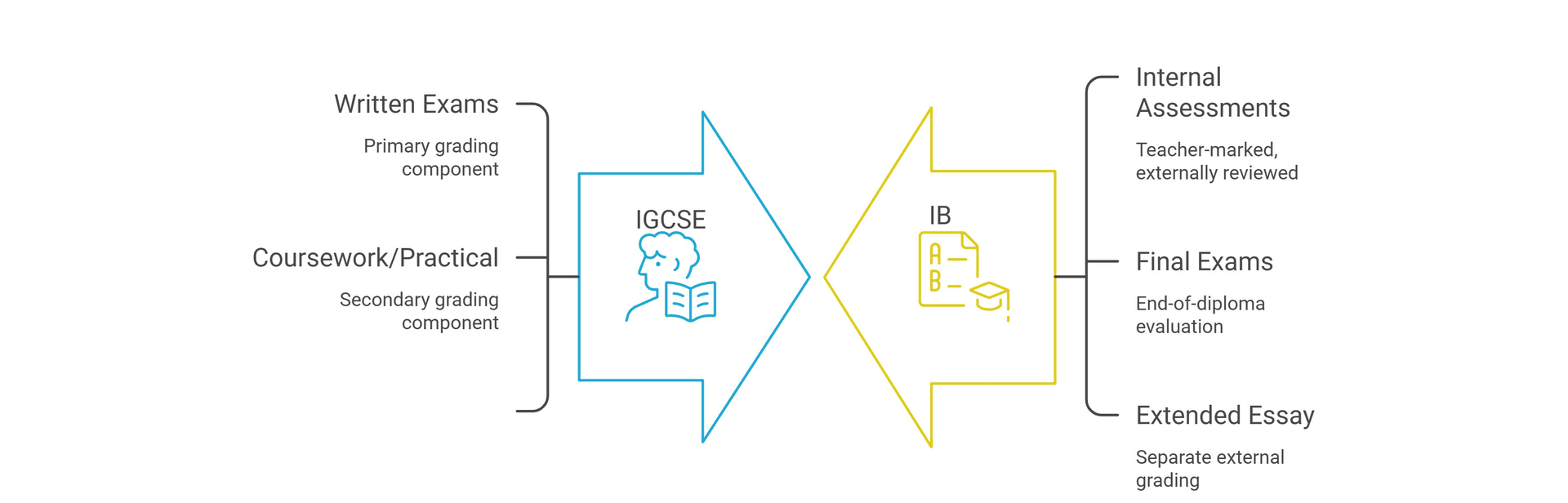
For most subjects, the grade depends on written exams at the end of the course. Some include coursework or a practical element, but exams carry the bulk of the weight. Students who prepare consistently and perform well under exam conditions generally do well here. There are no big surprises in the format.
In IB
Assessment runs across the full two years. Each subject has internal assessments, lab reports, oral presentations, essays, and investigations, marked by the teacher and then reviewed externally. Final exams happen at the end of the Diploma. The Extended Essay is graded separately by an external examiner.
What this means practically: IB students are being assessed almost constantly. Some find it less stressful than a single high-stakes exam window. Others find the sustained pressure harder to manage. Both reactions are completely understandable.
Also Read- IB vs CBSE vs IGCSE: Which Study Board Is Right for You?
So Which One Should Your Child Do?
Three things drive this decision more than anything else: how your child learns, where they want to go for university, and how much workload they can handle without it affecting their health or motivation.
IGCSE tends to work better
When your child is in the 14 to 16 age group and still figuring out where their academic strengths lie. IGCSE gives them room to explore without locking them into a rigid structure. It also works well as a foundation for A-Levels or the IB Diploma later. Students who prefer clear frameworks and perform well in exams often thrive here.
The IB Diploma tends to work better
When your child is genuinely self-motivated, curious across multiple subjects, and has university plans that involve studying abroad. US, UK, Canadian, and European universities know the IB well and look at it favourably. Students who finish the Diploma are usually well-prepared for the pace and expectations of undergraduate study.
Picking the Right Path: What Comes Next
Here is what most of the “IB vs IGCSE” articles online will not tell you: the difference between IB and IGCSE is not really about which programme is more prestigious. Both are respected. Both are demanding. What actually matters is the fit, whether the programme matches how your child thinks, works, and what they are hoping to do after school.
IGCSE lays a strong, focused foundation at the secondary level. IB builds the kind of breadth and independence that global universities specifically look for. Pick the one that suits your child, not the one that sounds more impressive at a dinner party.
At HUS, we work alongside students and have seen firsthand what makes the difference between struggling and excelling in each. If you want a straight conversation about which path makes sense for your child’s goals and learning style, reach out to our academic team.
References
FAQ's
Age group and purpose. IGCSE is designed for students aged 14 to 16 and focuses on subject-specific knowledge through structured exams. The IB Diploma is for students aged 16 to 19 and takes a much broader approach; students study across six subject groups while completing a research essay and two other core components. The two programmes are not really in competition; many students do IGCSE first and then move into the IB.
In terms of overall workload, yes, the IB Diploma asks more of students. You are being assessed across more subjects at the same time, writing a 4,000-word research paper, completing CAS, and sitting for Theory of Knowledge on top of subject exams. That said, “harder” is relative. Students who enjoy independent work and are curious across subjects often find IB more engaging than exhausting.
Both are recognised globally. IGCSE is typically a secondary qualification; universities look at what students do after it, whether that is A-Levels or the IB Diploma. The IB Diploma is a university-entry qualification in its own right and is particularly well regarded by institutions in the US, UK, Canada, and Europe. If your child is aiming for universities abroad, the IB tends to carry more direct weight in admissions.
Yes, and it is one of the most common academic pathways in international schools. IGCSE between 14 and 16, followed by the IB Diploma from 16 to 19, is a well-established route. The subject knowledge and study habits built during IGCSE provide solid preparation for the demands of the IB.
No. There is no equivalent of TOK, the Extended Essay, or CAS in IGCSE. Students choose their subjects and are assessed within those subjects. This makes the IGCSE structure more straightforward, though the subject content itself is still academically demanding.
IGCSE offers more freedom in subject selection; students pick from over 70 options and are not required to cover every discipline. IB is less flexible here because all six subject groups are compulsory. Within individual subjects, though, IB tends to allow more open-ended inquiry, which some students find gives them greater intellectual room to explore their interests.
IGCSE uses a letter scale from A* at the top to G, with some regions now using a 9 to 1 numerical scale. IB grades each subject on a 1 to 7 scale, and the maximum total score is 45 points, which includes up to 3 bonus points from the Extended Essay and TOK combined. Both grading systems are well understood by universities worldwide.