What is the Theory of Knowledge in IB?

March 4, 2026
Table of contents
Most school subjects ask: what do you know? Theory of Knowledge asks something far more interesting: how do you know it? That single shift, from knowing facts to questioning knowledge itself, is what makes TOK one of the most distinctive parts of the IB Diploma. It sits alongside all of a student's other subjects and ties them together, building the kind of thinking skills that serve students well beyond any exam.
At HUS, TOK is a core part of the IB Diploma Programme, and this guide explains everything you need to know about it, in plain language.
Understanding TOK in the IB Curriculum
The TOK full form is Theory of Knowledge. It is the core component along with the Extended Essay and CAS in the IB Diploma Programme. TOK provides the platform for collaboration across the six-subject group. Students are encouraged to observe real-life situations in different subjects to validate their arguments. This exemplifies the real-world application of TOK. The knowledge questions given in the TOK subject guide are the fundamental tool for exploring the nature of knowledge.
Instead of asking "what is the answer?", TOK trains students to ask:
- How do we decide what counts as knowledge?
- What's the difference between an opinion and a fact?
- Can knowledge ever be fully objective?
- How does where you come from affect what you believe?
These aren't trick questions with single correct answers. TOK is about learning to reason carefully, weigh evidence, and see things from more than one angle.
In simple terms:
TOK doesn't ask students to learn more; it asks them to think better about what they already know.
Also Read- A Comprehensive Guide to IB Diploma Programme Subjects
Theory on Knowledge (TOK) Curriculum
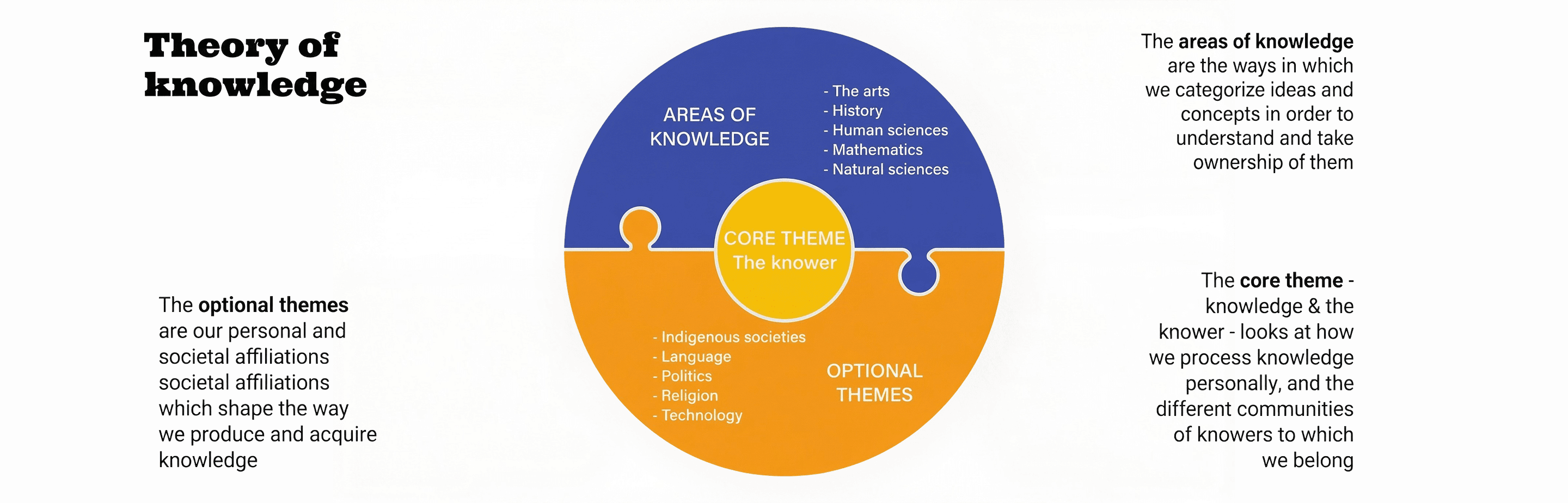
The TOK curriculum is made up of these deeply interconnected parts.
The core theme: Knowledge and the knower
This theme encourages students to reflect on themselves as knowers and thinkers, and to consider the different communities of knowers to which we belong.
Optional themes: This element provides an opportunity to take a more in-depth look at two themes of particular interest to teachers and students. The given themes all have a significant impact on the world today and play a key role in shaping people’s perspectives and identities. Teachers select two optional themes from a choice of five: knowledge and technology; knowledge and language; knowledge and politics; knowledge and religion; and knowledge and indigenous societies.
Areas of knowledge: The areas of knowledge (AOK) are specific branches of knowledge, each of which can be seen to have a distinct nature and sometimes uses different methods of gaining knowledge. In TOK, students explore five compulsory areas of knowledge: history; the human sciences; the natural sciences; mathematics; and the arts. Each discipline approaches knowledge differently through the knowledge questions given in the guide. For example:
- In Mathematics, knowledge feels certain, but did humans invent numbers, or discover them?
- In History, evidence is always incomplete. How do historians decide what really happened?
- In the Arts, meaning is often subjective. Can a painting communicate something that words cannot?
- In Natural Sciences, experimentation is central, but how much evidence is enough to call something a fact?
By exploring these questions across different subjects, students develop a richer understanding of how knowledge works and why it matters which field you're in.
To explore these three parts of the TOK curriculum, guidance and suggested knowledge questions are provided. These suggested knowledge questions are organized into a framework of four elements: scope, perspectives, methods and tools, and ethics. This "knowledge framework" encourages a deep exploration of each theme and AOK. Having these common elements run throughout the different parts of the curriculum also helps to unify the course and helps students to make effective connections and comparisons across the different themes and areas of knowledge.
Assessment in Theory of Knowledge IB
TOK has two assessment components. Together, they can contribute up to 3 bonus points to a student's overall IB Diploma score, which can genuinely affect final grade boundaries.
1. The TOK Exhibition (33%, marked internally)
Completed in Year 1, the Exhibition asks students to choose one prompt from a list of 35 provided by the IB, then select three real-world objects that connect to that prompt. They write a 950-word commentary explaining how each object illustrates a knowledge question.
Objects can be physical or digital, a photograph, a tweet, a newspaper article, or a scientific instrument. The key is connecting abstract TOK ideas to real things in the world.
- Example prompt: "What counts as good evidence for a claim?"
- Example prompt: “Are some types of knowledge more useful than others?”
2. The TOK Essay (67%, marked externally by the IB)
Written in Year 2, students choose one title from six released by the IB each year. The essay is 1,600 words and should be a genuine inquiry, not a list of facts, but a carefully reasoned exploration using two Areas of Knowledge.
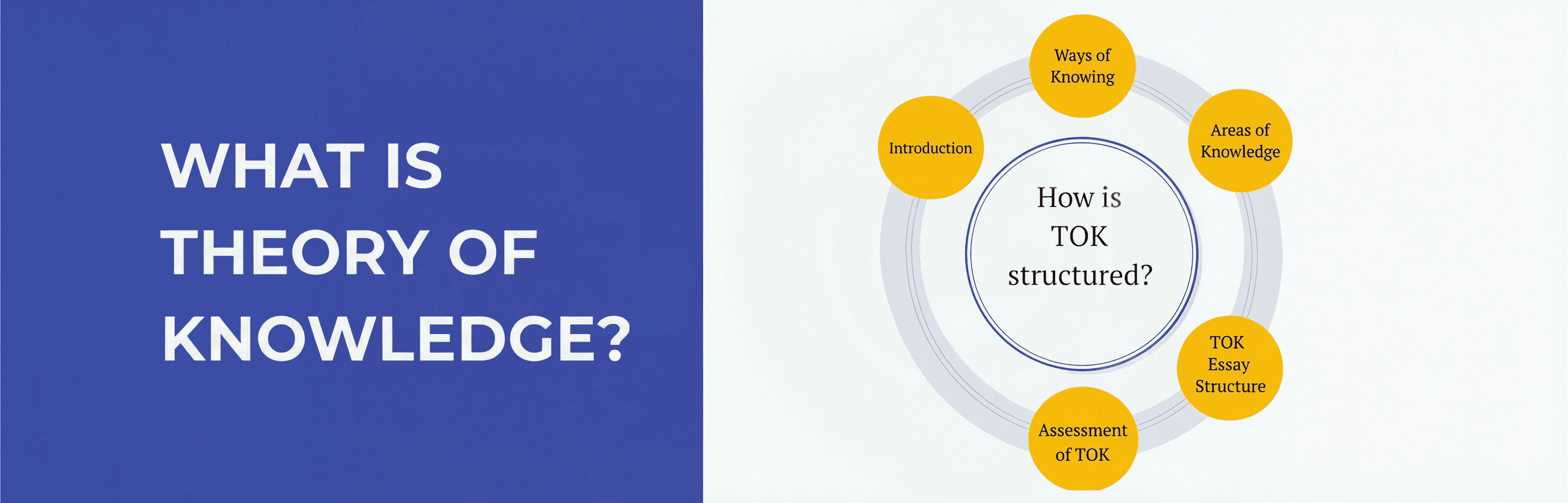
TOK Essay Ideal Structure & Format
Introduction (one paragraph - 150 - 200 words): includes context, purpose and thesis.
Body (multiple paragraphs - 1200 words): examines the statement and the student’s position. This is where your position and evidence (which may include personal examples) are discussed, as well as counterpoints. Sample paragraph template :
Claim/ counterclaim
Developing Sentence: Clarifies and expands on the topic sentence.
Supporting Sentences/ evidences: Provides supporting evidence for the topic/ developing sentence from an AOk.
Implication/ evaluation of your argument
Concluding/Linking Sentence: Concludes the paragraph and links to the next idea being discussed.
Conclusion (one paragraph - 150 words): restates the main points. This is short and does not state anything new, except perhaps discussing possible implications of the conclusion.
What examiners want:
Not the 'right answer', but clear, careful thinking that explores complexity and acknowledges more than one perspective.
Referencing
• All ideas, quotations, and examples not your own must be cited.
• Consistency is mandatory: choose one recognized referencing style (APA, MLA, Chicago, Harvard, etc.) and use it throughout.
• Bibliography/Works Cited page must be included at the end of the essay.
• Direct quotes: must include quotation marks and an in-text citation (e.g., author, year, page).
• Paraphrased ideas: even if reworded, must still be cited.
• Examples from media, history, or science: reference the source clearly (e.g., article, book, documentary).
• Must list all sources cited in the essay.
• Entries should follow the chosen style exactly (e.g., APA: Author, Year, Title, Publisher).
• Alphabetical order by author surname is standard.
• Avoid unreliable sources (blogs, Wikipedia, unverified websites).
• The IB does not mandate a single style but requires consistency and clarity.
• Word count (1,200–1,600 words) excludes references and bibliography.
• Plagiarism or improper referencing can result in the essay being disqualified
Key Theory of Knowledge (TOK) Concepts to Know
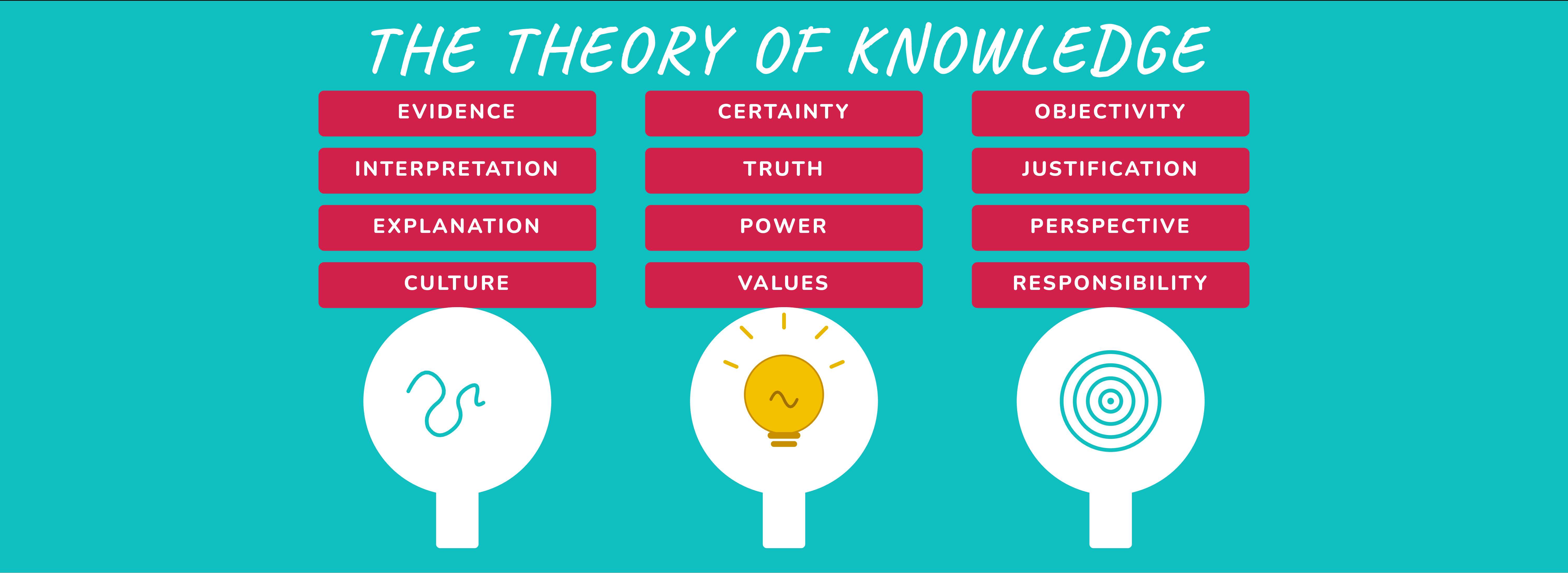
The Theory of Knowledge (TOK) course in the IBDP revolves around 12 central concepts. These concepts act as lenses through which knowledge can be explored, questioned, and understood.
1. Evidence
Evidence refers to the information or data used to support claims. In TOK, students examine what counts as reliable evidence across different Areas of Knowledge (AOKs).
2. Certainty
Certainty explores the degree of confidence we can have in knowledge claims. TOK encourages reflection on whether absolute certainty is possible in disciplines like mathematics versus ethics.
3. Truth
Truth is concerned with whether knowledge claims correspond to reality. TOK examines different theories of truth (correspondence, coherence, pragmatic) and their implications.
4. Interpretation
Interpretation highlights the role of perspective in understanding knowledge. In TOK, students analyze how texts, data, and events can be understood differently depending on context.
5. Power
Power refers to the influence that knowledge has in shaping societies and decisions. TOK considers how knowledge can empower individuals but also be used to control or manipulate.
6. Justification
Justification is about the reasoning behind knowledge claims. TOK asks what counts as a good justification in different disciplines and whether justification is always necessary.
7. Explanation
Explanation involves making sense of phenomena. TOK explores how explanations differ between natural sciences, human sciences, and the arts.
8. Objectivity
Objectivity refers to the attempt to minimize bias in knowledge production. TOK questions whether true objectivity is possible, especially in areas influenced by human values.
9. Perspective
Perspective emphasizes the importance of viewpoints in shaping knowledge. TOK encourages students to consider cultural, historical, and personal perspectives when evaluating claims.
10. Culture
Culture shapes how knowledge is created and understood. TOK examines how cultural traditions, values, and practices influence what is accepted as knowledge.
11. Values
Values are the principles and standards that guide judgments. TOK explores how values influence knowledge claims, especially in ethics and politics.
12. Responsibility
Responsibility refers to the ethical obligations tied to knowledge. TOK asks whether knowing something creates a duty to act, and how responsibility varies across contexts.
These 12 concepts are not isolated; they interconnect and overlap, forming the foundation of TOK discussions. By engaging with them, students develop critical thinking skills and a deeper appreciation of how knowledge is constructed and evaluated.
Why the Theory of Knowledge in IB Matters
The Theory of Knowledge IB course functions as a core requirement for the IB Diploma Programme, which schools must complete. According to the International Baccalaureate Organisation, over 8,700 programmes were being offered across more than 6,000 schools in over 160 countries.
The worldwide distribution of this method shows that people increasingly understand how inquiry-based learning helps students develop abilities to tackle future complex problems.
Taking the TOK assessment provides a range of benefits for students and enables them to develop essential skills, which include:
- Critical thinking skills
- Ethical reasoning
- Academic writing and structured argumentation
- Confidence in public speaking
- Analytical comparison across disciplines
Students who want to study abroad or enter competitive Indian universities gain an advantage during interviews and academic assessments because they develop reflective skills through their theory of knowledge ib studies.
HUS's method for teaching TOK
TOK is taught at Hiranandani Upscale School as part of the full IB Diploma Program for students in 11th and 12th grades. It shows how seriously the school takes the idea that learning should not only teach facts, but also how to think critically and freely.
They do more than just listen to lessons in the TOK class. During planned conversations, they argue, question, and test each other's reasoning. Instead of just giving answers, teachers help students come up with and defend well-thought-out views.
Parents of HUS students often notice that their kids are getting better at asking questions, making decisions based on evidence, and interacting with the world around them. This method is directly linked to those changes.
Also Read- Why Parents are Choosing IB Schools for their Children
TOK also links naturally to the other two components of the IB Diploma core, the Extended Essay and CAS (Creativity, Activity, Service), supporting conceptual learning while giving students a fully rounded intellectual and personal development experience.
Quick Tips for TOK Success
For the Exhibition
- Choose a prompt that genuinely interests you; authentic engagement shows
- Pick objects with a real story, not just ones that look impressive
- Every line of your commentary should connect back to the prompt
For the Essay
- Read all six titles before choosing, pick the one that opens up the most interesting questions
- Don't just argue one side. The best essays explore genuine complexity
- Use specific, well-chosen examples; vague generalisations score poorly
In General
- Keep a TOK journal: when an interesting knowledge question comes up in any subject, write it down
- Talking about TOK ideas outside class, it becomes more natural with practice
Final Thoughts
Theory of Knowledge is not just a box to tick in the IB Diploma. It is one of the features that makes the IB genuinely different from other curricula, and one of the most practically useful things a student can study.
Students who engage seriously with TOK leave school better equipped to read the world critically, argue clearly, and think independently. Those aren't just academic skills. They're life skills.
If you'd like to understand more about how the IB Diploma works at HUS, including TOK, the Extended Essay, and CAS, check out our IB Programmes, or get in touch with our admissions team.
References-
1. https://www.ibo.org/programmes/diploma-programme/curriculum/dp-core/theory-of-knowledge/what-is-tok/
FAQ's
TOK stands for Theory of Knowledge. It is one of three core components of the IB Diploma, alongside the Extended Essay and CAS.
TOK is challenging in a different way from most subjects; there's no content to memorise. Students who approach it with genuine curiosity tend to find it rewarding. The key skill is learning to structure your thinking clearly and engage honestly with complex questions.
The Exhibition accounts for 33% of the TOK grade (internally assessed), and the Essay accounts for 67% (externally marked by the IB). Together, they contribute up to 3 bonus points to the overall IB Diploma score out of 45.
The five AOKs are Mathematics, Natural Sciences, Human Sciences, History, and the Arts. Each is explored in terms of how knowledge is built, questioned, and communicated within that field.
A knowledge question is an open inquiry about how knowledge works, not a factual question with one answer. For example: "To what extent does language shape what we can think?" These questions drive TOK discussions and both assessed components.
Yes. The analytical writing, structured argumentation, and reflective thinking that TOK develops are highly valued by universities. The TOK Essay directly builds the kind of academic writing skills that universities expect from Day 1.
Not at all. The IB Diploma is recognised by leading Indian universities as well as global institutions. The critical thinking and communication skills TOK builds are valued by admissions teams everywhere.