How to Choose the Right Subjects from IBDP Subject Groups


April 21, 2026
Table Of Contents
Subject selection is one of the first major decisions you will make inside the IB Diploma. Pick the right combination, and the next two years feel purposeful. Get it wrong, and you may find yourself either underprepared for your university application or struggling through subjects that do not play to your strengths at all.
The challenge is that most students make this decision without a clear framework. They pick subjects they liked in middle school, copy their friends, or choose whatever seems manageable. None of those are bad instincts, but they are not enough on their own.
This guide provides a clear overview of the IB subject groups, what they entail, and a practical framework for choosing subjects for IB that align with your aspirations.
Understand How the IBDP Subject Groups Work
Every student in the IB Diploma studies six subjects, one from each of the six subject groups. That is not optional. The IB requires breadth across all groups because the programme is designed to develop well-rounded thinkers, not specialists in a single field.
Within that structure, though, there is real choice. You decide which specific subject to take from each group, and you decide whether to study three of your six subjects at Higher Level (HL) or Standard Level (SL). The remaining three go the other way.
Higher Level subjects involve more content, more depth, and more hours of study. They are also the subjects that universities typically look at most closely when assessing your application. Standard Level subjects still count fully toward your diploma, but they carry less weight in subject-specific university requirements.
Getting that balance right, three HL subjects that reflect your strengths and your university direction, is the most important part of building a good subject combination.
The Six IB Diploma Subject Groups at a Glance
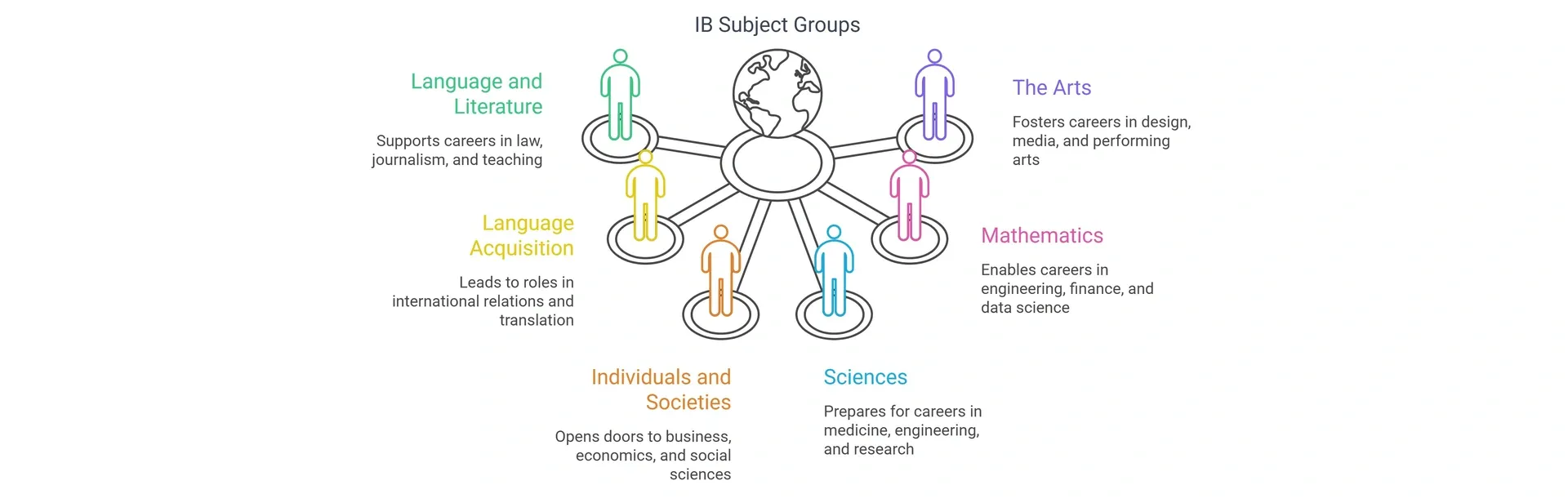
Here is a summary of all six IB subject groups, what falls within each one, and the kinds of career paths each group supports.
| Group | Subject Area | Subjects Available | Career Pathways |
|---|---|---|---|
| 1 | Studies in Language and Literature | Language A: Literature, Language A: Language and Literature, Literature and Performance | Law, journalism, communications, teaching, humanities |
| 2 | Language Acquisition | Language B (any language), Language ab initio, Classical Languages | International relations, translation, diplomacy, and global business |
| 3 | Individuals and Societies | History, Economics, Geography, Psychology, Business Management, Global Politics, Philosophy | Business, economics, social sciences, politics, research |
| 4 | Sciences | Biology, Chemistry, Physics, Computer Science, Design Technology, Environmental Systems | Medicine, engineering, research sciences, technology |
| 5 | Mathematics | Mathematics: Analysis and Approaches, Mathematics: Applications and Interpretation | Engineering, finance, data science, and actuarial studies |
| 6 | The Arts | Visual Arts, Music, Theatre, Dance, Film | Design, media, performing arts, creative industries |
Group 6 (The Arts) is the only group where students have the option to substitute. If you want to take an additional subject from Groups 3 or 4 instead of an arts subject, the IB allows that. So if you need two sciences or two humanities subjects for your university path, you can do that without taking a formal arts course.
Also Read- IB Board Vs CBSE: Understanding the Difference
What Each Subject Group Actually Involves
The IB Diploma is built around six subject groups, and you'll choose one subject from each, three at Higher Level (HL) and three at Standard Level (SL). Every group serves a distinct purpose in shaping how you think, argue, and build expertise. Here's a quick map of what each one covers.
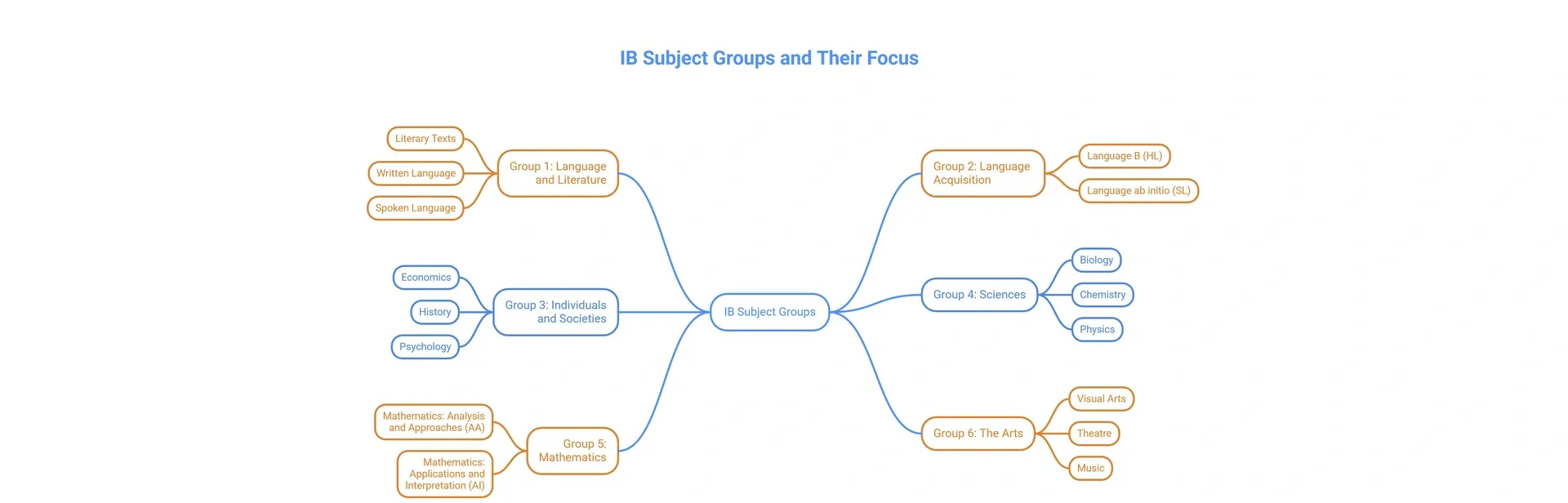
Each group plays a specific role in your profile.
Group 1 Language & Literature: Your strongest language. For most Indian international school students, this is English. Suits strong readers and analytical writers.
Group 2 Language Acquisition: A second language. Take it at HL if you already speak it confidently; choose ab initio SL if you're starting fresh. Valuable for business, diplomacy, and global careers.
Group 3 Individuals & Societies: The humanities and social sciences. Economics and Business suit finance and management pathways. History and Global Politics suit law and public policy. Psychology suits medicine and behavioural fields.
Group 4 Sciences: The gateway to medicine, engineering, and STEM degrees. Biology + Chemistry HL for medicine. Physics + Maths for engineering. Computer Science HL is increasingly valued by top tech programmes.
Group 5 Mathematics: One of the most consequential choices you'll make.
Maths AA- theoretical, proof-based, calculus-heavy. Required for engineering, physics, and pure maths at most top universities.
Maths AI- applied, statistics and modelling. Suits business, social sciences, design, and data-driven fields.
Always check the specific entry requirements of your target universities, some name AA HL directly.
Group 6 The Arts: Visual Arts, Theatre, Music, Dance, Film. Don't underestimate the workload; arts subjects are demanding, just assessed differently. A genuine choice here can make an application stand out. If your pathway needs two subjects from Groups 3 or 4, you can swap the arts subject for an additional one from those groups.
Also read- A Comprehensive Guide to IB Diploma Programme Subjects
How to Decide Which Subjects to Take at a Higher Level
Most students find this the hardest part. You need three HL subjects, and they need to do two things at once: reflect your academic strengths and align with your university requirements.
Start with your university direction. Look at the entry requirements for the courses you are genuinely considering, even if you are not fully decided yet. Note which subjects are specified as required or preferred, and at what level. That gives you a floor to work from.
Then look honestly at your own abilities. HL subjects are more demanding, and you will spend significantly more time on them than on your SL subjects. Choosing three HL subjects where you have a genuine foundation makes the two years more manageable and your final results more competitive.
A common mistake students make is choosing HL subjects they think look impressive without considering whether they can sustain strong performance in them over two years. A consistent 6 at SL is more useful in most cases than a 4 at HL.
Subject Combinations by University Goal
This table is a starting point, not a fixed prescription. University requirements vary by institution and by year, so always check directly with the universities you are considering.
| Career Goal | Recommended HL Subjects | Useful SL Subjects |
|---|---|---|
| Medicine or Dentistry | Biology, Chemistry, and one of Maths or Physics | Psychology, another science, or a language |
| Engineering | Physics, Mathematics: Analysis and Approaches, Chemistry | Computer Science or Design Technology |
| Economics or Finance | Economics, Mathematics: Analysis and Approaches | Business Management, a second language |
| Law | History or Global Politics, one language | Psychology, Philosophy, another humanities subjects |
| Computer Science / Tech | Computer Science, Mathematics: Analysis and Approaches | Physics or Design Technology |
| Business or Management | Economics or Business Management, a language | History or Geography, Mathematics |
| Creative Arts | Theatre, Visual Arts, or Film, a language | History or Philosophy, English Literature |
| Social Sciences / Research | Psychology, History or Geography | Philosophy, a language, Mathematics: Applications |
A Few Practical Things Worth Knowing Before You Decide
Not every school offers every subject
The IB has over 30 subjects across its six groups, but your school will offer a selection of these. Before you map out your ideal combination, check which subjects are actually available at your school and whether the school offers your preferred subjects at both HL and SL.
Your combination should make sense together
A subject combination that looks good on paper but has no internal logic can work against you. If you are aiming for a science degree, having History at HL without a strong science alongside it will raise questions for admissions tutors. Think about whether your three HL subjects tell a coherent story about your academic direction.
Switching subjects is harder than it sounds
Some students change one subject in the early weeks of DP1, and that can be fine. Changing subjects after the first few months is significantly more disruptive because the two-year programme starts building on itself quickly. Take the time up front to make a considered decision rather than treating it as something you can easily adjust later.
Also Read- How IB Education Prepares Students for Life Beyond School
Choosing Well Sets You Up for Everything That Follows
At HUS, our academic team works closely with students through the subject selection process, helping them think through their choices in relation to their individual goals and university aspirations. If you would like guidance on building a subject combination that works for your path, we encourage you to speak with your academic advisor or reach out to our team directly.
References
FAQ's
Yes. The IB Diploma requires one subject from each of the six subject groups. The only exception is Group 6, where you can substitute an additional subject from Groups 1 to 4 if your academic path requires it. All other groups are mandatory.
You take three subjects at Higher Level and three at Standard Level. Some schools allow students to take four HL subjects, though this is less common and significantly increases the workload. Most students and advisors recommend sticking with the standard three HL, three SL split unless there is a specific reason to do otherwise
It is possible to change subjects in the early stages of DP1, but it becomes increasingly difficult as the programme progresses. Each subject builds on itself, so switching late means catching up on content while continuing with everything else. It is far better to invest proper time in the selection process before you begin than to make adjustments after the fact.
It depends on the degree you are applying for. Medicine programmes almost universally require Biology and Chemistry at HL. Engineering programmes typically ask for Physics and Mathematics: Analysis and Approaches at HL. Law and humanities degrees often value History, Economics, or a language at HL. Always check entry requirements for the specific universities and courses you are targeting rather than relying on general guidance.
Mathematics: Analysis and Approaches is more theoretical and focuses on calculus, proof, and abstract mathematical reasoning. It is the preferred choice for students heading into engineering, physics, or mathematics. Mathematics: Applications and Interpretation focuses more on statistical analysis and real-world problem solving. It is better suited to students in social sciences, business, or fields where data literacy matters but advanced theoretical maths is not required.
Both matter, and the best choices usually satisfy both. A subject you enjoy is one you are more likely to engage with deeply over two years, which generally leads to better results. A subject your target university requires is non-negotiable. Where possible, look for subjects that sit at the intersection of genuine interest and university relevance. When the two conflict, university requirements should usually take priority, but it is worth discussing specific cases with your academic advisor.
Not necessarily. If an arts subject does not suit your academic direction, you can substitute it with an additional subject from Groups 1 to 4. This is a formal option within the IB Diploma structure and is used by many students, particularly those with strong science or humanities pathways that benefit from a sixth academic subject rather than an arts course.