Key Differences Between IB Early Years and Traditional Preschool

February 19, 2026
Table of contents
Choosing the right preschool is one of the first major decisions parents make in their child’s educational journey. With options like the IB Early Years programme and traditional preschools, the differences can sometimes feel unclear yet significant.
While traditional preschools often follow a structured approach focused on foundational literacy and numeracy skills, the IB Early Years framework emphasises inquiry-based learning, exploration, and holistic development. Understanding how these approaches differ can help parents make an informed choice that aligns with their child’s needs and long-term goals.
Comparing Learning Approaches: Traditional and IB Preschool
Traditional preschools are what most of us remember. Kids learn their letters, count to twenty, and maybe finger paint on Fridays. There's usually a clear schedule, and teachers have a curriculum they follow.
The IB curriculum for preschool works differently. It's built around the Primary Years Programme framework, specifically designed for young learners. Instead of teaching subjects separately, everything connects through big themes that kids explore over several weeks.
At HUS, you'll see both models in action across different schools. The IB preschool curriculum has been growing in popularity, but it's still newer to many Indian parents compared to the traditional setup.
How do kids spend their day?
Here's where things get practical.
In a traditional preschool:
- 9:00 AM - Circle time, calendar, weather
- 9:30 AM - Letter of the week activities
- 10:00 AM - Snack time
- 10:30 AM - Math games or counting practice
- 11:00 AM - Art project (usually related to a theme)
- 11:30 AM - Outdoor play
- 12:00 PM - Story time and dismissal
Everything has its slot. Teachers know exactly what they're covering each day.
In an IB Early Years Classroom:
The day looks looser, but it's actually carefully planned around whatever unit they're investigating. Maybe they're exploring "How the World Works" for six weeks.
Kids might spend an hour at the water table testing which materials float. Then they'll draw their observations, discuss why things happened, and maybe read books about boats and rivers. The teacher follows their questions rather than a strict timetable.
What Curriculum Actually Means in Each Place
Traditional Preschool Curriculum:
- Pre-reading skills such as phonics, letter recognition, and rhyming.
- Basic math practices like counting, shapes, patterns, and simple addition.
- Fine motor development, such as cutting, tracing, and writing.
- Social skills like everyone should share, take turns, and follow the rules.
- Science and social studies through weekly themes.
Teachers usually have workbooks or activity sheets. There are learning objectives for each week or month. Parents get progress reports showing which skills their child has mastered.
The IB early years programme:
Instead of subjects, there are six big themes every child explores throughout the year:
- Who are we?
- Where are we in place and time?
- How do we express ourselves?
- How does the world work?
- How do we organize ourselves?
- Sharing the planet.
Let's say the class is doing "Where are we in place and time?" Kids might:
- Build maps of their neighborhood with blocks.
- Interview grandparents about what the area looked like before.
- Sort old and new photos.
- Visit a local historical site.
- Create timelines of their own lives.
- Compare homes in different countries.
They're doing math by measuring, counting, and mapping. Literacy involves interviewing, writing, and reading. Science has materials, structures, and social studies, all mixed because that's how the real world works.
The IB curriculum for preschool still teaches letters and numbers, just not in isolation.
Teacher’s Role
Traditional preschool teacher:
- Plans lessons based on the curriculum guide.
- Leads activities and demonstrations.
- Corrects mistakes and provides answers.
- Manages classroom behavior.
- Assesses whether kids met learning goals.
It's pretty clear who's in charge. The teacher has the knowledge and passes it along.
IB EYP teacher:
This role is harder to explain because much of its impact happens behind the scenes.. They're setting up provocations, asking questions instead of giving answers, documenting what kids discover, and figuring out where the inquiry should go next based on student interest.
When a kid asks, "Why do leaves change color?" the traditional teacher might explain or read a book about it. The IB preschool curriculum teacher asks, "How could we find out?" and suddenly you've got a month-long investigation with leaf collecting, color mixing, observation journals, and expert visitors.
Both are skilled educators. They're just playing completely different roles.
Also Read- The Role of Colours in Early Childhood Development
The Classroom Comparison About Everything
Walk into both types of classrooms, and you'll immediately see the difference.
Traditional Setup:
- Desks or tables in rows or clusters.
- The alphabet is posted above the board.
- The teacher's desk is at the front.
- Reading corner, blocks corner, dramatic play area (usually separate).
- Student work displayed (often identical projects).
- Job chart, behavior chart, calendar area.
IB Early Years Classroom:
- Learning centers everywhere (investigation table, art studio, building area, quiet reading space, sensory area).
- The current inquiry theme is visible through the documentation panels.
- Children's questions are posted on walls.
- Works in progress, not finished products.
- Materials are organized for independent access.
- Very few identical projects because kids investigate different aspects.
The IB early year environment is designed for kids to move around, choose their work, and spend long periods engaged with materials. Traditional rooms are built for group instruction and adult-led activities.
Also Read- Why Choose the IB Early Years Programme? Key Benefits for Students
How They Measure If Kids Are Learning
This matters more than parents often realize upfront.
Traditional assessment:
- Skills checklists that assess early learning milestones and everyday classroom readiness.
- Periodic testing or worksheets.
- Report cards with grades or development levels.
- Portfolio of completed work samples.
- Teacher observations are noted on forms.
You get clear feedback: your child knows 15 out of 26 letters, can count to 30, and needs work on scissors skills.
IB curriculum for preschool assessment:
- Ongoing observations recorded through photos and notes.
- Learning stories that document the process, not just the outcome.
- Portfolios showing development over time.
- Student reflections (even preschoolers can talk about their learning).
- Exhibitions where kids present what they've discovered.
It's less about "can your child do X" and more about "how is your child approaching learning."
Some parents find this frustrating because it's vague. Others love that it captures the full picture rather than reducing their kid to a checklist.
What Parents Are Expected to Do?
Traditional preschool:
- Read the weekly newsletter.
- Practice skills at home if suggested
- Attend parent-teacher conferences twice a year.
- Maybe volunteer for parties or field trips.
- Help with homework if the school assigns it.
It's supportive but not intensive.
With the IB Early Years Programme:
Parents are considered part of the learning community. Schools like HUS actively involve families because the IB EYP framework sees home and school as connected, not separate.
You might be asked to:
- Share family traditions related to the current inquiry.
- Send in materials from home, like photos, objects, and stories.
- Talk with your child about what they're investigating.
- Attend student-led conferences where your preschooler explains their learning.
- Come to unit celebrations or exhibitions.
- Contribute your expertise if it connects to the theme.
It's more work, but many parents find it keeps them connected to what's actually happening in school.
The Skills Kids Gain
After two or three years in each type of program, what do kids actually know and do differently?
Traditional preschool graduates typically:
- Recognize all letters and sounds.
- Count to 100, recognize numbers, and do simple math.
- Write their name and some basic words.
- Follow classroom routines and teacher directions well.
- Know how to sit still, raise hands, and wait their turn.
- Have covered science and social studies topics such as weather, community helpers, seasons, and animals.
They're academically ready for kindergarten. Teachers love them because they know how school works.
Early childhood research also supports why play-based learning matters. Harvard’s Center on the Developing Child explains that play helps children build executive function skills like self-control, working memory, and flexible thinking, skills that influence how well children learn, collaborate, and adapt in school over time.
IB early year program graduates typically:
- Have solid literacy and math foundations (learned through application, not drills).
- Ask lots of questions and know how to investigate answers.
- Work well in groups and communicate their thoughts.
- Make connections between different ideas.
- Are comfortable with ambiguity and open-ended problems.
- Have developed learning skills like observing, researching, thinking, communicating, and self-managing.
They're also ready for kindergarten, but they've built different strengths. They might not sit as quietly, but they're more likely to ask "why" and propose solutions.
Does the IB Preschool Curriculum Actually Prepare Kids for School?
This is what parents really want to know. If your child attends an IB curriculum in preschool and then enters a traditional elementary school, will they be behind? The IB early years programme still covers foundational academics; they learn to read, write, and do math. They just learn it embedded in meaningful contexts.
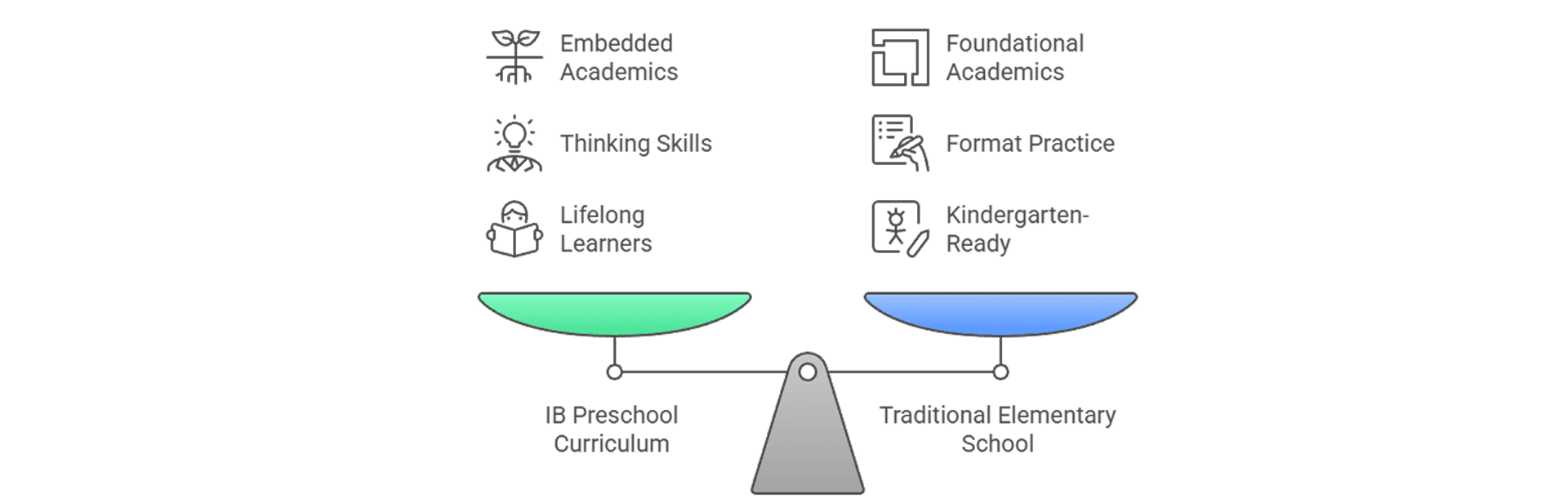
What they gain are thinking skills and learning dispositions that serve them regardless of what educational model comes next. They're used to figuring things out, working with others, and sticking with challenges.
They might have more practice with the format of traditional schooling, which can be an advantage in the short term. Long-term outcomes? That depends on too many factors to make sweeping claims, but the IB preschool curriculum was specifically designed to develop lifelong learners, not just kindergarten-ready students.
So Which One Should You Choose?
There is no right way to choose between the IB early years programme and traditional preschool. Some children thrive in an IB Environment because they are creative, curious, and enthusiastic about learning through exploration, inquiry, and a global perspective.
Other children may do better in a traditional preschool because they need routine, consistent, and clearly defined milestones, as well as more structured routines for their learning. In the end, the way your child responds, teacher quality, school culture, and class size all matter significantly. Connect with our admissions team to explore the right early learning pathway for your child.