Daycare vs Preschool: What's the Difference?

September 15, 2026
Table Of Content
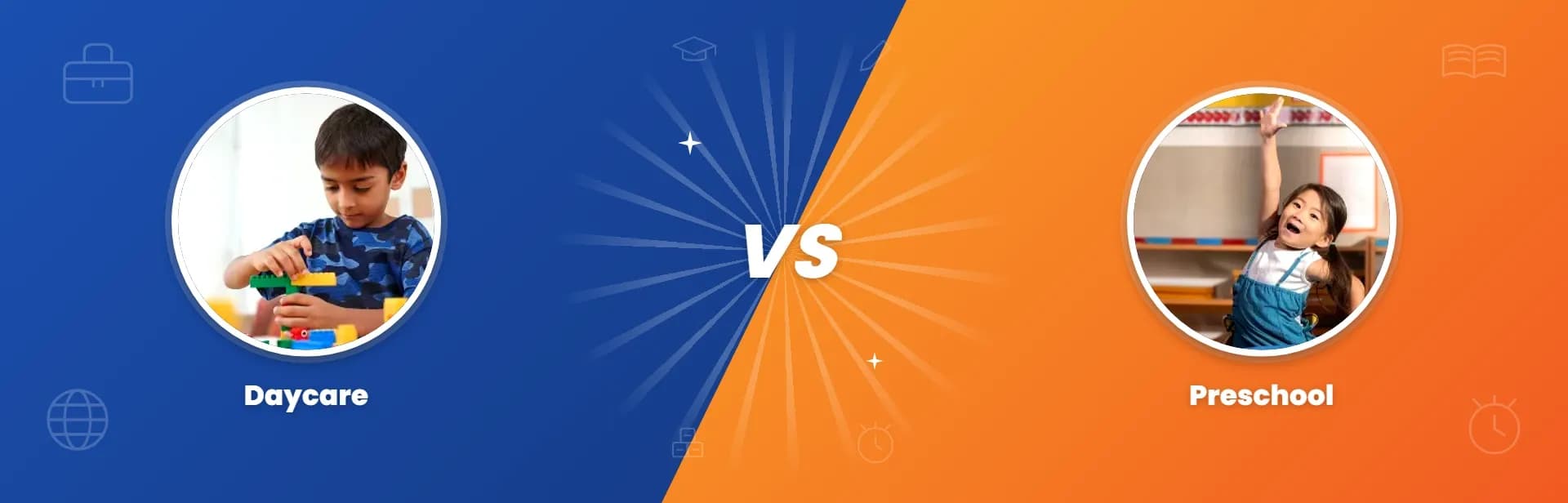
Daycare is primarily a childcare service for infants through young children while parents work, run on flexible hours with a loose daily routine. Preschool is a structured early education programme for children roughly age two and a half to six, run on fixed school-term hours with a planned curriculum. Both can look similar in photos, but the purpose, hours, and daily structure behind each are genuinely different.
What Is Daycare?
Daycare, sometimes called a creche, is built around supervision and care rather than a fixed academic curriculum. It typically accepts children from a few months old through the early primary years, runs extended hours to match a full working day, and follows a flexible routine of meals, naps, and free play rather than planned lessons.
What Is Preschool?
Preschool is an early education setting for children roughly between two and a half and six years old, run in term-time hours similar to a school day. It follows a planned curriculum built around early literacy, numeracy, and social-emotional skills, delivered by staff trained specifically in early childhood education rather than general childcare. Programmes built on an inquiry-based learning approach go further, encouraging children to ask questions and explore rather than just follow instructions.
Daycare and Preschool: What's the Real Difference?
Day care and preschool get used almost interchangeably in everyday conversation, but once you line them up side by side across the areas parents actually ask about, the gap becomes obvious.
| Area | Daycare | Preschool |
| Primary purpose | Supervised childcare | Structured early education |
| Typical age range | A few months to 5 years | 2.5 to 6 years |
| Hours | Extended, full working day | Fixed, term-time school hours |
| Daily structure | Flexible: meals, naps, free play | Planned lessons and activities |
| Staff training | General childcare training | Early childhood education qualification |
| Academic focus | Minimal to none | Early literacy, numeracy, inquiry skills |
| Typical fee structure | Charged per month or per hour of care | Charged per term, tied to the academic calendar |
What Do Preschoolers Learn That Daycare Doesn't Cover?
Because preschool follows a planned curriculum, preschoolers build specific skills that a purely custodial daycare setting does not set out to teach.
- Early literacy: letter recognition, phonics, and listening to and retelling stories.
- Early numeracy: counting, sorting, comparing sizes, and recognising simple patterns.
- Social-emotional skills: sharing, turn-taking, naming feelings, and resolving small conflicts with guidance rather than a caregiver simply stepping in.
- Inquiry and independence: asking questions, making choices within structured activities, and following a group routine.
How Do You Choose Between Daycare and Preschool?
There's no universal right answer in the daycare vs preschool decision. It usually comes down to two questions: how many hours of coverage a family actually needs, and how ready a child is for a structured learning routine.

- Choose daycare if you need coverage across a full working day, including outside typical school terms, for a child under two and a half.
- Choose preschool once a child is ready for a structured, term-time routine with planned early learning, usually from age two and a half onward.
- Some families use daycare for the working hours a preschool day doesn't cover, combining both rather than choosing one over the other.
What Should You Check Before Enrolling in Either?
Whether you're comparing day care and preschool options or centres within the same category, a short visit answers more than a website ever will.
- Staff-to-child ratio: lower ratios mean more individual attention, especially important for children under three.
- Safety and hygiene: check nap areas, washroom facilities, and how meals and snacks are handled, particularly for a daycare setting covering longer hours.
- A visible daily schedule: a genuine preschool should be able to show you a weekly plan, not just describe activities in general terms.
- How transitions are handled: ask how staff settle a child in during the first few weeks, since this affects daycare and preschool experiences differently given the hours involved.
Choosing Between Daycare and Preschool in Chennai?
Daycare and preschool solve two different problems: one covers a working day, the other builds early learning through a planned routine. Many good early years programmes now combine both, offering full-day day care in Chennai built around a genuine curriculum rather than forcing a choice between the two.
If you're weighing up the difference between IB Early Years and a traditional preschool alongside daycare, it helps to see a programme that covers both in one place. Plan a visit through IB admissions in Chennai to see the daily routine for yourself, or compare it against our broader guide to top schools in Chennai before you decide.
References
FAQ's
Most preschools accept children from around two and a half to three years old, once they can manage a structured group routine for part of the day.
Yes, in India the terms are largely used interchangeably to describe childcare-focused settings, as distinct from a curriculum-driven preschool.
Yes. Many families use daycare before or after preschool hours, or during school holidays, to cover a full working day around a structured preschool morning.
A good preschool builds the early literacy, numeracy, and social-emotional skills that make the transition to primary school smoother, though the specific readiness expected varies by the primary curriculum a child moves into next.