What Makes a Good IB PYP Classroom? A Parent's Checklist

August 26, 2026
Table Of Content
When visiting an international school, it's easy to be impressed by modern classrooms, colourful walls, and advanced facilities. But what truly makes an IB Primary Years Programme (PYP) classroom exceptional goes far beyond appearances.
A great PYP classroom is designed to inspire curiosity, encourage independent thinking, and help children become active participants in their own learning. Instead of simply receiving information, students ask questions, investigate ideas, collaborate with classmates, and reflect on their learning.
If you're exploring the best international schools in Chennai, here's a practical checklist to help you identify a high-quality IB PYP classroom.
What is the IB Primary Years Programme (PYP)?
The IB Primary Years Programme (PYP) is designed for children aged 3 to 12 years and forms the first stage of the International Baccalaureate (IB) Continuum.
Unlike traditional education systems that focus primarily on textbooks and examinations, the PYP encourages children to explore concepts through inquiry, real-world experiences, and interdisciplinary learning.
Its goal is to develop curious, confident, and compassionate learners while building the skills required for future stages of the IB Continuum, including the Middle Years Programme (MYP) and Diploma Programme (DP).
1. Inquiry is at the Centre of Learning
One of the strongest indicators of an effective PYP classroom is an atmosphere of curiosity.
Instead of providing immediate answers, teachers encourage students to ask questions, investigate ideas, and discover solutions independently.
Look for:
- Inquiry questions displayed around the classroom
- Wonder walls where students record their questions
- Student journals and learning reflections
- Evidence of ongoing investigations and projects
A classroom filled with thoughtful questions is often a stronger indicator of learning than one filled with completed worksheets.
2. Students Take Ownership of Their Learning
A good PYP classroom belongs to the students.
Rather than classrooms designed only for visitors, you'll notice spaces that reflect children's thinking and creativity.
Signs include:
- Student-created displays
- Project work
- Learning journals
- Student-generated questions
- Easily accessible learning materials
Children should be able to make choices, explore independently, and contribute actively to the classroom environment.
3. Teachers Guide Rather Than Lecture
In an IB classroom, the teacher is a facilitator of learning rather than the sole source of knowledge.
Instead of asking students to memorise facts, teachers encourage discussion by asking questions such as:
- "What do you think?"
- "Why do you believe that?"
- "How could we find out?"
This approach helps children develop confidence, critical thinking, and independent problem-solving skills.
4. Flexible Learning Spaces
PYP classrooms are designed to support different styles of learning.
Rather than fixed seating arrangements, you'll often find flexible spaces that allow students to work individually, in pairs, or as part of larger collaborative groups.
Look for:
- Movable furniture
- Collaborative workstations
- Reading corners
- Reflection spaces
- Open discussion areas
These adaptable environments give students greater ownership of how they learn.
5. Learning Extends Across Subjects

One of the defining features of the PYP is transdisciplinary learning.
Instead of studying subjects separately, students explore broad themes that naturally connect areas such as:
- Language
- Mathematics
- Science
- Social Studies
- Arts
This integrated approach helps children understand how knowledge applies in real-world situations.
6. The IB Learner Profile is Visible in Daily Learning
The IB Learner Profile forms an important part of every PYP classroom.
Students are encouraged to become:
- Inquirers
- Thinkers
- Communicators
- Caring individuals
- Principled learners
- Open-minded
- Reflective
- Risk-takers
- Balanced
- Knowledgeable
Rather than simply displaying these attributes on posters, effective classrooms actively incorporate them into discussions, projects, and student reflection.
7. Learning Walls Tell the Story of Growth
The best PYP classrooms have walls that evolve throughout the learning process.
Instead of decorative posters, you'll see:
- Student questions
- Concept maps
- Research findings
- Classroom discussions
- Project progress
- Reflections and conclusions
These learning walls demonstrate that education is an ongoing journey rather than a finished product.
8. Collaboration is Part of Everyday Learning
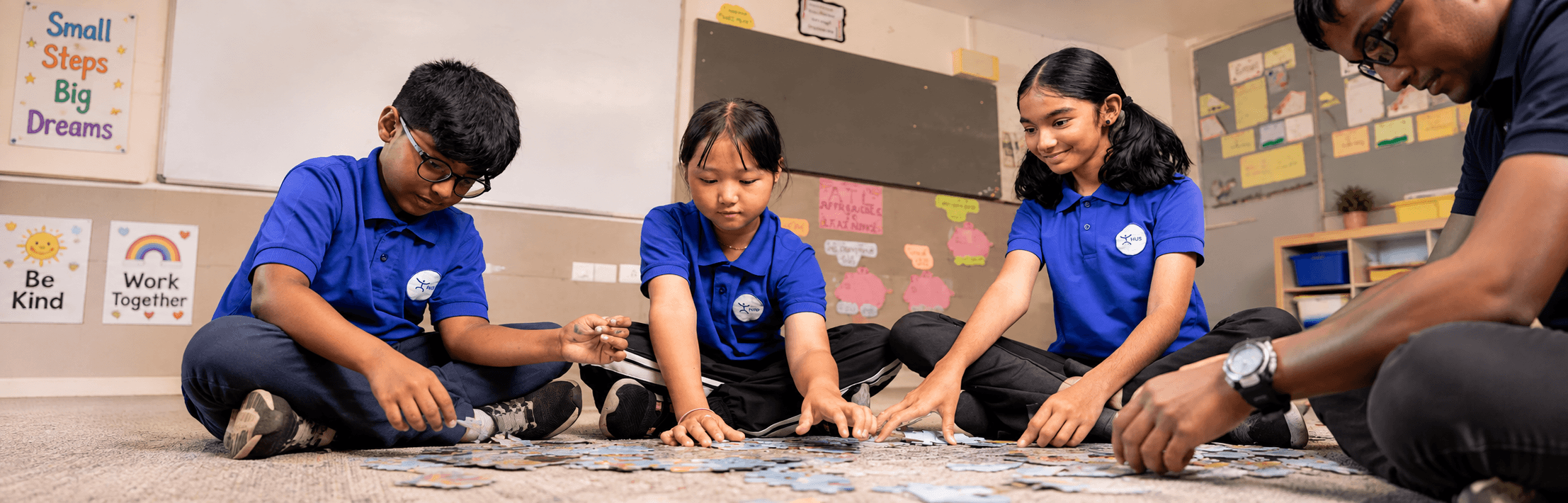
Collaboration is a key part of inquiry-based education.
Students regularly work together to:
- Solve problems
- Conduct investigations
- Share ideas
- Give peer feedback
- Present their learning
These experiences strengthen communication, teamwork, and leadership skills while helping children learn from one another.
A Parent's Checklist During a School Visit
When touring a PYP school, ask yourself:
- Are students asking questions rather than simply answering them?
- Is student work displayed throughout the classroom?
- Are classrooms flexible and designed for collaboration?
- Do teachers encourage discussion and independent thinking?
- Are inquiry projects visible?
- Is the IB Learner Profile integrated into classroom life?
- Do children appear engaged, curious, and confident?
If the answer is "yes" to most of these questions, you're likely looking at a classroom where the PYP philosophy is genuinely being practised.
Final Thoughts
A great IB PYP classroom is more than an attractive learning space,it is an environment where children develop curiosity, confidence, collaboration, and critical thinking every day.
By encouraging inquiry, student ownership, flexible learning, and meaningful collaboration, the PYP prepares students not only for the Middle Years Programme (MYP) and Diploma Programme (DP) but also for lifelong learning.
For parents choosing among the best international schools in Chennai, observing the classroom in action is one of the best ways to understand whether a school truly embraces the philosophy of the IB Primary Years Programme.
FAQ's
The IB Primary Years Programme is an inquiry-based curriculum for children aged 6–12 years. It focuses on developing critical thinking, collaboration, communication, and curiosity through transdisciplinary learning.
Look for inquiry-based learning, student-created displays, flexible learning spaces, collaborative activities, visible learning walls, and teachers who facilitate discussion rather than simply deliver lessons.
Units of Inquiry are central learning experiences in the PYP that connect multiple subjects around real-world themes, encouraging students to investigate concepts from different perspectives.
The IB Learner Profile consists of ten attributes,including being an inquirer, thinker, communicator, and reflective learner,that help students develop academically, socially, and emotionally.
The PYP develops inquiry, research, communication, collaboration, and self-management skills from an early age, providing a strong foundation for success in the Middle Years Programme and the IB Diploma Programme.
Visit classrooms, observe teaching practices, speak with educators, and look for evidence of inquiry-based learning, student ownership, collaboration, and a genuine implementation of the IB philosophy.