IB School Fees Structure in India: What You're Actually Paying For


June 9, 2026
IB School Fees Structure in India: What You're Actually Paying For and What to Ask Before You Enrol. The IB school fees structure in India is one of the first questions parents ask — The IB school fees structure in India is often one of the first questions parents have when considering an international education for their child. An IB education spans four interconnected programmes from Early Years to Diploma, and each carries a distinct cost logic tied to curriculum delivery, faculty training, and IB organisation accreditation.Before making an enrolment decision, look beyond the overall fee amount and understand what contributes to the school's fee structure.
Why Is the IB Fees Structure Higher Than Most Indian School Programmes?
The IB fees structure reflects a fundamentally different cost base from standard CBSE or ICSE schools. IB World Schools pay annual authorisation and accreditation fees to the International Baccalaureate Organisation in Geneva. IB educators undergo continuous professional development through programme-specific workshops and category training, ensuring they remain aligned with evolving IB standards and best practices.
Beyond compliance costs, class sizes are deliberately capped. At Hiranandani Upscale School (HUS) in Chennai, the Early Years Programme (EYP) and Primary Years Programme (PYP) maintain a maximum of 20 students per class; the Middle Years Programme (MYP) and Diploma Programme (DP) cap at 25. Smaller classes mean more teaching staff per student — a direct driver of fees that genuinely improves learning outcomes.
The fees structure also funds specialised infrastructure: science labs, performing arts studios, study lounges, fitness centres, and dedicated EYP rooms are not optional add-ons in an IB environment — they are programme requirements.
What Does the IB Fees Structure Actually Cover Across the Four Programmes?
Understanding the IB fees structure means understanding what each of the four programmes delivers:
EYP (IB Early Years Programme): For children aged 1.6 to 5.6 years, fees cover play-based inquiry curriculum,trained educators for early childhood , and facilities like dedicated EYP rooms and outdoor play areas.
PYP (IB Primary Years Programme): Ages 6 to 11. Fees fund transdisciplinary units of inquiry, specialist subject teachers (arts, physical education, languages), and the Exhibition project in Year 6.
MYP (IB Middle Years Programme): Ages 11 to 16. The fees structure at MYP level includes e-assessments, community service coordination, and interdisciplinary project delivery across eight subject groups.
DP (IB Diploma Programme): Ages 16 to 19. This is typically the most intensive fees tier. It covers external examinations set and marked by IB, the Extended Essay supervision, Theory of Knowledge, and CAS (Creativity, Activity, Service) programme coordination.
A school offering all four — an IB Continuum school — also invests in vertical curriculum alignment so a child's learning builds coherently from age 1.6 to 19. That continuity has a real cost, and it shows in the fees structure.
Key Factors to Consider Before Accepting an IB School's Fee Structure
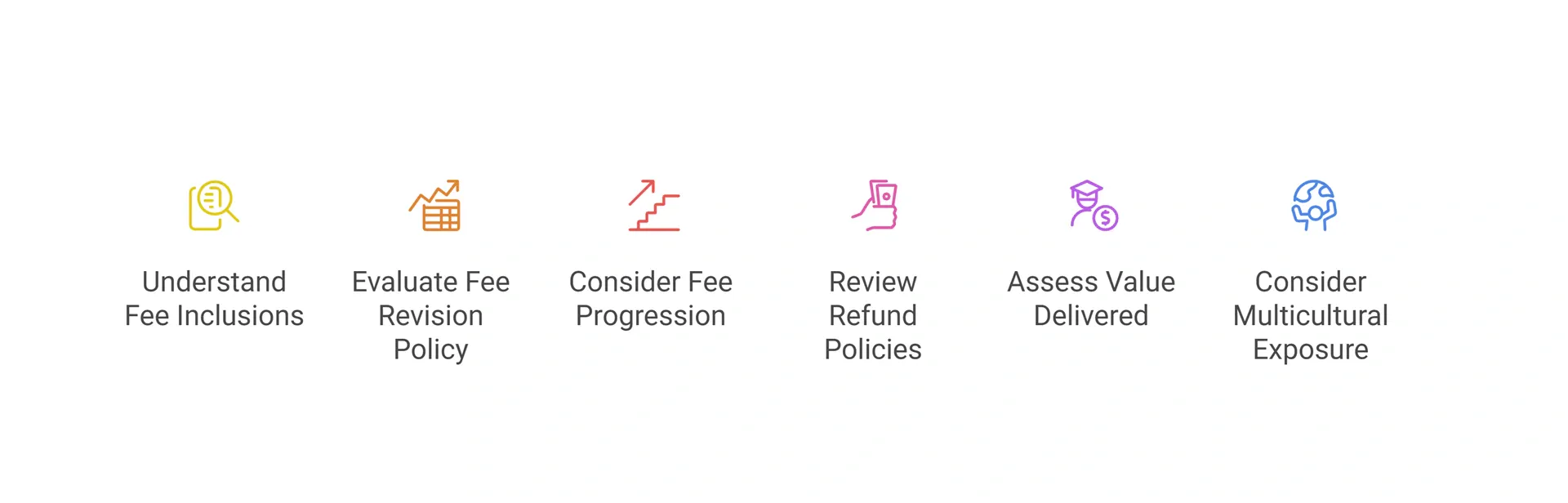
Look beyond the headline tuition fee and understand what is included versus what may be billed separately. Costs related to examinations, extracurricular activities, transportation, uniforms, and device programmes are often charged independently and can significantly impact the overall investment.
Evaluate the school's fee revision policy to understand how fees may change over time. Reviewing the average annual fee increase over the past few years and the notice period provided before revisions can help families plan financially with greater confidence.
Consider how the fee structure evolves across different stages of the IB continuum. Progression from the Primary Years Programme (PYP) to the Middle Years Programme (MYP) and eventually to the Diploma Programme (DP) often involves an increase in fees. Assessing the complete educational journey rather than focusing solely on the first year provides a more accurate picture of the long-term commitment.
Review the institution's refund and withdrawal policies before making any payments. Some schools may retain a full term's fees in the event of withdrawal, making it essential to clarify these terms in advance.
Assess the value delivered in relation to the fees by examining the school's university placement outcomes. At HUS, 98% of students have achieved successful placements, helping parents understand the return on investment associated with an IB education.
Consider the role of multicultural exposure when evaluating the fee structure. Delivering an authentic international education involves operational elements that extend beyond academics. Supporting students from 9+ nationalities, as HUS does, requires multilingual support systems, internationally sourced learning resources, and community-building initiatives that foster global perspectives. While these aspects may not be immediately visible within the fee breakdown, they represent a significant component of the value families receive through an internationally diverse learning environment.
FAQ's
The IB fees structure generally covers tuition, IB curriculum delivery, teacher professional development, IB organisation fees, and access to school facilities including labs, libraries, and sports infrastructure. Items such as examination registration fees, transport, uniforms, and optional activity programmes are usually billed separately. Always request a full fee schedule — not just annual tuition — before enrolling.
Each IB programme has a distinct cost structure. The DP carries the highest fees because it includes externally set and marked IB examinations, Extended Essay supervision, and Theory of Knowledge delivery. The PYP and EYP have lower fees but still require specialist teachers and IB-accredited facilities. A full IB Continuum school will have a tiered fees structure that increases as students progress.
Enrolling at an IB Continuum school that offers EYP through DP can be more efficient than moving between schools at each programme transition. Curriculum continuity reduces academic adjustment time, and families avoid re-application costs and potential gaps in IB methodology. Over a 12–15 year education journey, curriculum coherence has measurable academic and logistical value.
Verify the complete fee schedule including all non-tuition charges, the annual revision clause, the refund and withdrawal policy, payment schedule options, and whether examination fees are billed separately. Ask specifically about fees at the next programme transition point — not just the current year's figure.
Evaluate the fees structure against: IB authorisation status, class size caps, faculty qualifications and IB training records, university placement data, facility quality, and the breadth of programmes offered. Hiranandani Upscale School (HUS) in Chennai offers all four IB programmes — EYP, PYP, MYP, and DP — with a 98% student placement record and a multicultural campus of 5,000+ students from 9+ nationalities, providing benchmarks against which to measure fees at any IB school.
Location influences fees through land and infrastructure costs, but it also affects lifestyle and community value. HUS is located on OMR (Old Mahabalipuram Road) in Chennai, beside Muttukadu Lake, near Sipcot IT Park — offering families in Chennai's technology corridor proximity to both a premium school and a professionally convenient address. Connectivity and campus environment are legitimate components of total value when assessing a fees structure.