What Is a Unit of Inquiry in the IB PYP? A Complete Guide for Parents

November 4, 2026
Table Of Content
If your child is about to start the IB PYP, you will soon hear one phrase again and again: Unit of Inquiry. The IB PYP (International Baccalaureate Primary Years Programme) organises learning through Units of Inquiry: structured, transdisciplinary learning journeys that guide students aged 6 to 11 to explore big ideas through questioning, research, and reflection. Each unit connects multiple subject areas around a Central Idea, building genuine understanding rather than rote recall. The framework uses six units per year, forming the Programme of Inquiry for every grade level.
In this guide, we break down how a unit works, what it contains, how it is assessed, and how you can support your child at home.
What Does a Unit of Inquiry Mean in the IB PYP?
A Unit of Inquiry is a planned, purposeful investigation into a significant concept. Unlike a standard school topic, a unit is not about memorising facts. It encourages students to inquire, question, and construct meaning.
Each unit belongs to one of six transdisciplinary themes that the International Baccalaureate Primary Years Programme uses to organise the curriculum globally, such as “How We Organise Ourselves” or “Sharing the Planet.” These themes connect learning to real-world experiences and encourage students to develop a global perspective.
How Does a Unit of Inquiry Work?
Teachers design each unit around a Central Idea and supporting Lines of Inquiry, then guide students through the inquiry cycle: tuning in, finding out, sorting out, going further, making conclusions, and taking action. Students are not passive recipients. They drive questions, conduct research, and collaborate with peers.
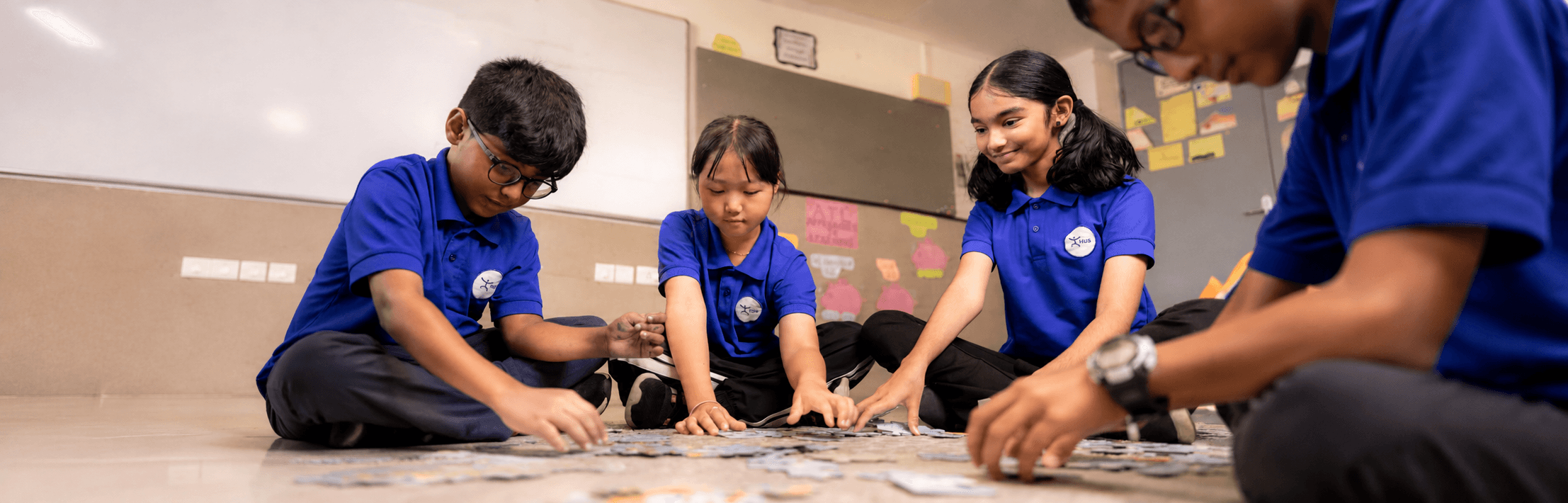
At Hiranandani Upscale School (HUS) in Chennai, the IB PYP framework enables students aged 6 to 11 to experience exactly this kind of active, student-centred learning across all four IB programmes offered on campus.
Key Elements of a PYP Unit of Inquiry
Every unit within the PYP curriculum contains five essential structural elements:
- Central Idea: the big, transferable concept students will understand by the unit's end
- Lines of Inquiry: three to four guiding questions that break the Central Idea into explorable strands
- Specified Concepts: lenses like form, function, causation, and responsibility through which students examine content
- Learner Profile Attributes: IB qualities such as being inquirers, thinkers, and communicators that the unit actively develops
- Action: a student-initiated response demonstrating genuine understanding and social responsibility
What Is a Central Idea?
The Central Idea is the conceptual heart of every IB PYP unit. It is a single, well-constructed, open-ended statement that captures a transferable understanding: something true beyond one subject, one classroom, or one country. A strong Central Idea might read: “Systems depend on the interaction of their parts.
Students spend four to six weeks unpacking this idea across subjects, building the kind of deep comprehension that the IB Primary Years Programme prioritises over surface-level content coverage. The Central Idea is what students should be able to articulate, in their own words, long after the unit concludes.
What Are Lines of Inquiry?
Lines of Inquiry are derived from the specified concepts within a Unit of Inquiry and guide students in exploring the Central Idea in greater depth. They define the key areas of investigation, helping students examine the Central Idea from different perspectives and build conceptual understanding through questioning, exploration, and reflection.
How Are Subjects Integrated into a Unit?
The IB PYP uses a transdisciplinary model, meaning subjects do not exist in isolation. A unit on "How the World Works" might integrate:
- Science: understanding natural systems
- Mathematics: measuring and analysing data
- Language arts: reading and writing about findings
- Social studies: examining human responses to natural phenomena
This integration reflects how the International Baccalaureate Primary Years Programme prepares students to think across disciplines, a critical skill for navigating an interconnected world.
The IB PYP uses a transdisciplinary approach, connecting different subject areas to help students explore concepts from multiple perspectives. A unit on “How the World Works” might integrate:
- Science: Understanding natural systems
- Mathematics: Measuring and analysing data
- Language Arts: Reading, writing, and communicating findings
- Social Studies: Examining human responses to natural phenomena
- Visual Arts: Expressing ideas through drawings, models, and creative projects
- Physical Education: Exploring movement, coordination, and physical responses to the environment
- Music and Drama: Communicating concepts through rhythm, performance, and storytelling
This approach connects academic learning with co-curricular experiences, encouraging students to apply their knowledge creatively, make meaningful connections, and develop a broader understanding of the world around them.
How Does Inquiry-Based Learning Work?
Inquiry-based learning, the pedagogical foundation of the IB PYP, positions students as active constructors of knowledge. Teachers act as facilitators rather than lecturers. Students generate their own questions, test ideas, gather evidence, and revise their thinking, mirroring the process real-world thinkers and problem-solvers use.
At HUS Chennai, with class sizes capped at 25 students for the PYP, this approach receives the individual attention it demands, ensuring every child's inquiry is genuinely supported.
How Do Teachers Assess Students?
Assessment in the IB PYP is ongoing, multidimensional, and purpose-built for inquiry. Teachers combine formative tools (observations, anecdotal records, student reflections, and portfolios) with summative tasks at the unit's conclusion.
How Does a Unit Develop Critical Thinking Skills?

Critical thinking is embedded structurally into every IB PYP unit through Key Concepts that demand analysis beyond surface recall. When a student examines "causation," they must ask why and how, not just what. When they explore "perspective," they must consider multiple viewpoints before forming a position.
The design is deliberate: the IB Primary Years Programme aims to produce lifelong learners who interrogate ideas rather than accept them passively. Over six years of PYP learning, these thinking habits become instinctive.
How Does a Unit Develop Critical Thinking Skills?
In the IB Primary Years Programme (PYP), critical thinking is developed through inquiry, questioning, and the Approaches to Learning (ATL) skills. Students learn to analyse information, identify patterns, consider different perspectives, and use evidence to form their own conclusions.
For example, while exploring scientific concepts, students may investigate why some objects float while others sink. During a unit on sustainability, they may examine waste management and suggest ways to reduce waste. These experiences encourage students to question assumptions, evaluate possibilities, and apply their learning to real-world situations.
By engaging in inquiry and reflection, students gradually develop the ability to think independently, make informed decisions, and approach challenges from different perspectives.
How Long Does a PYP Unit of Inquiry Last?
Each IB PYP unit runs for approximately four to six weeks, giving students sufficient time to move through the full inquiry cycle without rushing. Six units run across the school year, collectively forming the Programme of Inquiry.
This structure ensures breadth, covering all six transdisciplinary themes, while preserving the depth that genuine inquiry requires. Shorter explorations risk superficial understanding; the IB's four-to-six-week model strikes a deliberate balance.
Can Parents Support a Child's Unit of Inquiry at Home?
Parents play a meaningful role in strengthening IB PYP learning beyond school hours. Simple strategies include:
- Ask open questions about the current unit: "What are you wondering about?" rather than "What did you learn today?"
- Connect the Central Idea to everyday life. If the unit explores systems, discuss how your home, neighbourhood, or family operates as a system.
- Visit libraries, museums, or community spaces that connect to the unit's theme.
- Encourage student action. The IB PYP expects students to respond to their learning with real-world action, however small.
- Review the unit planner shared by the school, which outlines the Central Idea and Lines of Inquiry for the term.
At HUS Chennai, the admissions and academic teams actively support parents in understanding the PYP curriculum so families and school remain aligned throughout every unit.
FAQ's
The IB PYP (International Baccalaureate Primary Years Programme) is a globally recognised curriculum framework designed for students aged 6 to 11. It focuses on inquiry-based, transdisciplinary learning that develops academic skills alongside personal qualities such as empathy, curiosity, and resilience. The programme prepares students for the IB Middle Years Programme and, ultimately, lifelong learning in an interconnected world.
Every IB PYP student completes six Units of Inquiry per academic year, one for each of the IB's six transdisciplinary themes: "Who We Are," "Where We Are in Place and Time," "How We Express Ourselves," "How the World Works," "How We Organise Ourselves," and "Sharing the Planet." Together, they form the Programme of Inquiry for the grade level.
The Central Idea is the overarching concept that students investigate throughout the entire unit, a transferable statement true beyond any single context. Lines of Inquiry are the three or four eframe this to connection between central idea, lines of inquiry, specified concepts-focused sub-questions that break it into manageable, explorable strands. In short, the Central Idea is the destination; the Lines of Inquiry are the routes students take to reach genuine understanding.
The Central Idea, specified concepts, and Lines of Inquiry work together to guide learning in an IB PYP unit.
- Central Idea: Establishes the overarching understanding students are expected to develop.
- Specified Concepts: Provide conceptual lenses through which students explore and question the Central Idea.
- Lines of Inquiry: Identify the specific areas of exploration derived from the specified concepts, guiding students towards a deeper understanding of the Central Idea.
- Student Inquiry: Through questioning, investigation, and reflection, students build knowledge, develop conceptual understanding, strengthen skills, and identify opportunities for meaningful action.
Together, these elements create a purposeful learning journey that encourages students to explore not only what they learn, but also why it matters, how it connects to the world, and how they can apply their understanding beyond the classroom.
No. The IB PYP does not rely on traditional, standardised exams for primary-age students. Assessment is continuous and multi-modal: teachers use observations, portfolios, student reflections, peer assessments. This reflects the programme's belief that authentic understanding cannot be measured by a single test score.
Hiranandani Upscale School (HUS) in Chennai delivers the IB PYP for students aged 6 to 11, with a maximum class size of 20 to ensure individual attention. HUS offers the full IB Continuum (EYP, PYP, MYP, and DP), providing students with a consistent, inquiry-led educational journey from Early Years through to the Diploma Programme.
With students from 9+ nationalities on campus and a 98% university placement record, HUS translates the PYP curriculum into measurable, real-world outcomes. Admissions for 2027–28 are open at hus.edu.in.
Yes. Students transitioning into the IB PYP from non-IB schools can join mid-year, subject to seat availability and the school's admissions process. HUS conducts a campus interaction and assessment to understand each child's learning profile before confirmation of enrollment. Because the programme emphasises skills and dispositions over content coverage, students with strong curiosity and a willingness to ask questions adapt well to the inquiry-based model.