Documents Required for IB School Admission in India


June 21, 2026
Table of Contents
Most IB school admissions in India stall for one unglamorous reason: a missing document. The list of IB documents itself is short and predictable once you know what schools look for. Below is exactly which documents are required for IB admission, why each one matters, and how to keep the verification stage from holding things up.
The Core IB Documents Every School Asks For
Almost every IB school in India asks for the same baseline set of IB documents. Keep clear scans and at least one set of photocopies of each:
- The child’s birth certificate or another official age proof
- Government ID for the child and both parents (Aadhaar or passport)
- Recent passport-size photographs of the child
- Report cards or mark sheets from the current and previous school
- A transfer certificate (TC) from the last school attended
- Address proof, such as a utility bill, rental agreement or passport
Have the originals ready as well — schools usually verify them in person. Together, these make up the standard IB school admission documents that schools in Chennai, Bengaluru, Mumbai and Delhi all tend to request, so the IB admission documents India parents prepare are broadly the same wherever you live.
Identity and age proof
Age decides which programme your child enters, so age proof sits at the top of the pile. A birth certificate is the cleanest option, and the date on it should match every other document exactly. Even a small mismatch between the birth certificate and a passport can trigger questions during verification. If the certificate is in a regional language, a translated copy saves a round of back-and-forth later.
Academic records from the current school
For any child past the early years, schools want recent report cards or mark sheets, usually for the last one to two years. These help the admissions team place your child correctly and flag any support they may need. A child moving into the Diploma Programme should expect closer attention to Grade 9 and 10 records.
Transfer certificate and address proof
The transfer certificate from the previous school confirms your child has formally left, and most schools will not finalise enrolment without it. Address proof is routine but easy to forget, so keep a recent utility bill or rental agreement handy.
Extra IB Documents for International or Transferring Students
Families relocating from abroad, or switching from a different board, usually need a few more documents required for IB admission:
- The child’s passport and valid visa, or an OCI card where relevant
- School records in English, with certified translations if the originals are in another language
- Immunisation or health records, which some schools request
- An equivalence certificate from the Association of Indian Universities for certain foreign qualifications
If you are switching boards, it also helps to understand how the system works before you apply — this guide to the International Baccalaureate covers the essentials.
IB Document Verification: What Schools Actually Check
IB document verification is rarely dramatic, but it is thorough. Admissions teams typically confirm that the name and date of birth read the same across every document, that the transfer certificate is genuine and signed by the previous school, and that copies are attested where required. Bring originals to the interaction or campus visit, since most schools cross-check them against your submitted copies on the spot. Keep a couple of extra attested photocopies on hand too, as some schools retain a set for their own records. Getting this right early is the simplest way to avoid a delayed offer.
Matching IB Documents to the Right Programme
The exact paperwork shifts slightly by entry point, because each IB programme admits a different age group. The youngest applicants joining the Early Years Programme mainly need age and identity proof, while children entering the Primary Years Programme and the Middle Years Programme also need academic records. Students applying to the Diploma Programme face the most detailed check, since their previous secondary results matter for placement.
Your IB School Admission Documents Checklist
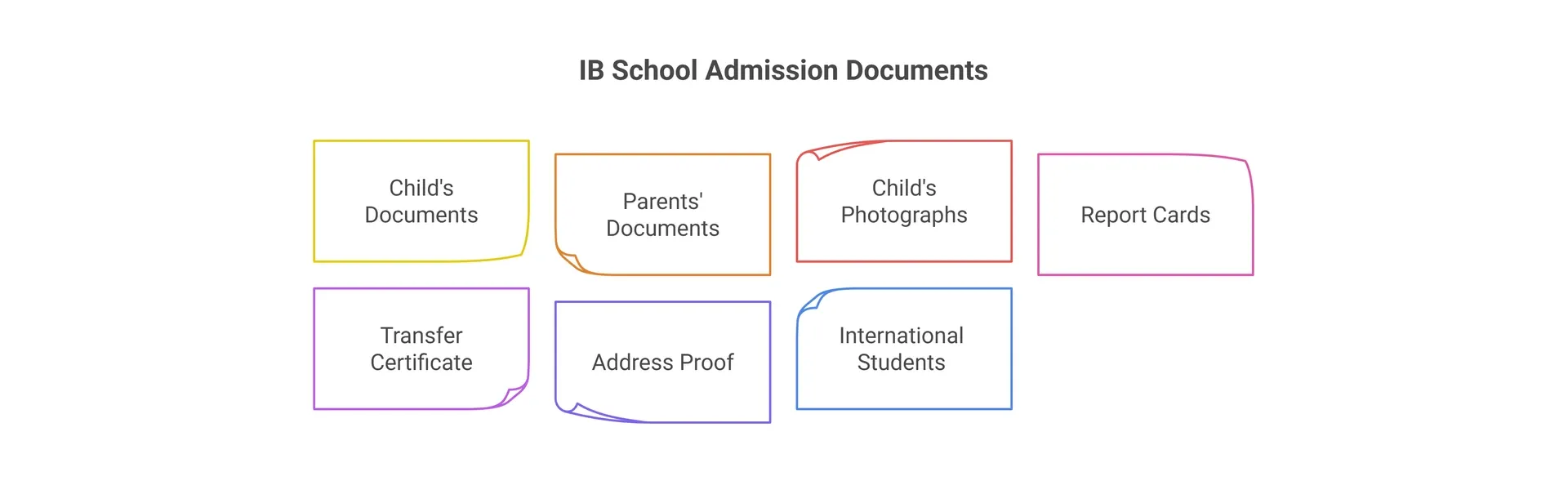
Before you hit submit, run through this quick IB admission checklist so nothing is missing:
- Birth certificate and a government photo ID for the child
- Aadhaar or passport for both parents
- Recent passport-size photographs of the child
- Report cards or mark sheets for the last one to two years
- Transfer certificate from the current school
- Address proof — a utility bill, rental agreement or passport
- For international students: passport, visa or OCI, translations and any equivalence certificate
Tick each item off, keep the originals plus one attested set, and the IB documents stage of your application will move quickly.
Mistakes That Delay Your IB Documents Submission
A handful of avoidable slip-ups account for most hold-ups:
- Submitting documents with mismatched names or spellings
- Forgetting the transfer certificate until the last minute
- Bringing photocopies but no originals to the campus visit
- Missing translations for non-English records
Build your IB admission checklist early, scan everything once, and keep a labelled folder, both digital and physical. It sounds basic, but it is the difference between a smooth admission and a stressful one.
Get Your IB Documents Ready Before You Apply
The documents required for IB admission in India come down to identity, age, academic history and a clean transfer record, with a little extra for international applicants. Sort them before you apply and verification becomes a formality. When you are ready, you can review the full IB requirements and begin your application with confidence.
References
FAQ's
Typically a birth certificate, ID for the child and parents, photographs, recent report cards, a transfer certificate and address proof. International students may also need a passport, visa and translated records.
In almost all cases, yes. Schools use it to confirm your child has formally left the previous school, and enrolment is rarely finalised without it.
It is the school’s check that your submitted documents are genuine and consistent — matching names and dates of birth, a valid transfer certificate, and attested copies where needed.
Only for certain foreign qualifications. The Association of Indian Universities issues equivalence certificates that some schools request for students arriving from overseas boards.
As early as possible. Gathering and scanning everything before you apply prevents the most common cause of delayed admissions.