How to Convert IB Scores to GPA (With a Free Tool)

July 11, 2026
Table Of Contents
Applying to a US university with an IB Diploma is straightforward in theory. Most admissions teams ask for your GPA on the 4.0 scale. The catch is that IB scores run on a 1 to 7 scale per subject and total out of 45, not 4.0. If you are still working through the diploma itself, our step-by-step guide to earning the IB Diploma covers the scoring structure in full. Knowing how to translate your ib score to gpa accurately matters, both for your university applications and for understanding where you actually stand.
Why the IB Score to GPA Conversion Exists
US universities use the 4.0 GPA scale almost universally. Schools across India, the UK, and most other countries use different systems. When you apply to a US university with an IB Diploma, admissions officers need a way to compare you with American applicants. They either ask for your converted GPA, or they recalculate it internally.
The ib to gpa conversion is the bridge. It is also useful for students applying for scholarships, exchange programmes, or summer schools that ask for GPA in their forms.
The Standard IB Score to GPA Conversion Table
The most widely used unweighted scale assigns the following GPA value to each IB subject grade:
| IB Score | GPA (4.0 Scale) |
| 7 | 4.0 |
| 6 | 3.7 |
| 5 | 3.3 |
| 4 | 2.7 |
| 3 | 2.0 |
| 2 | 1.0 |
| 1 | 0.0 |
This is the most common unweighted version. Some schools use slightly different mappings, but this one is closest to the average across US universities.
Weighted vs Unweighted GPA in the IB
US high schools often distinguish between standard, honours, and Advanced Placement courses by adjusting GPA upward. The same logic applies when colleges weight IB courses:
- HL courses often add 1.0 point. An HL 7 becomes 5.0 instead of 4.0.
- SL courses often add 0.5 point. An SL 7 becomes 4.5 instead of 4.0.
If a university asks for a weighted GPA, apply the above. If they ask for unweighted, stick with the basic table. Because weighting depends on which subjects you take at HL, choosing the right DP subjects has a direct effect on your final converted GPA.
How to Convert Your IB Score to GPA in Three Steps
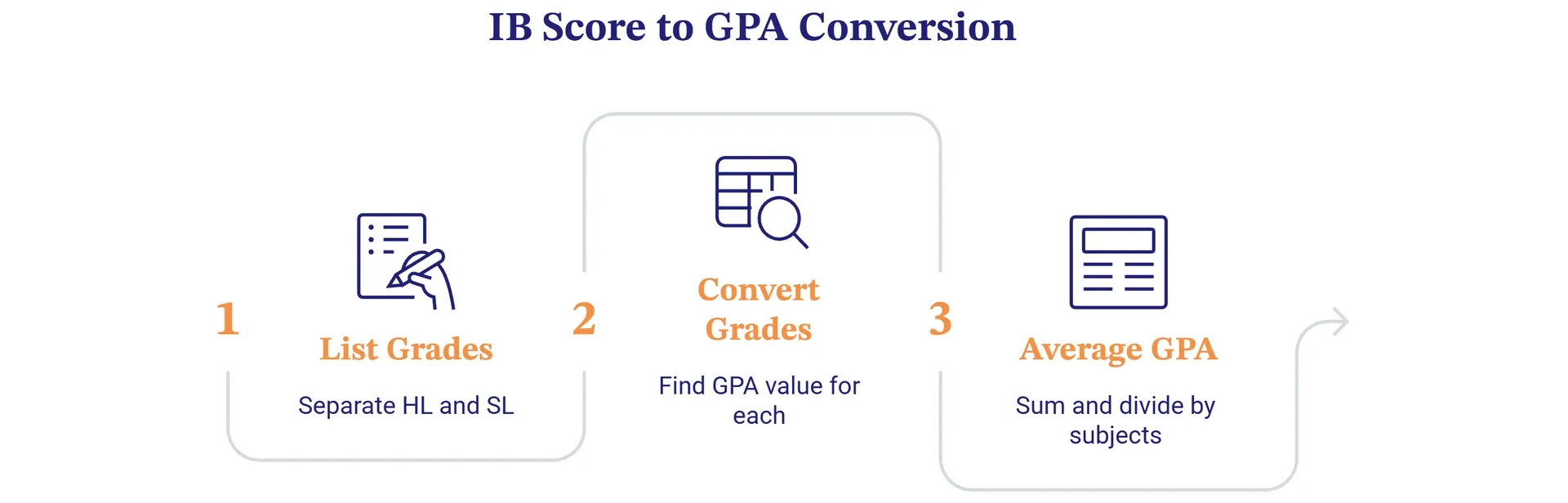
- List every subject grade from your IB transcript, separating HL and SL.
- Look up each grade in the conversion table above to get its GPA value.
- Average all the GPA values together by adding them up and dividing by the number of subjects (usually 6).
Example: A student with HL grades 7, 6, 5 and SL grades 7, 6, 5 has GPA values of 4.0, 3.7, 3.3, 4.0, 3.7, 3.3. Total = 22.0. Divided by 6 = 3.67 unweighted GPA.
If the university uses weighting: HL becomes 5.0, 4.7, 4.3; SL becomes 4.5, 4.2, 3.8. Total = 26.5. Divided by 6 = 4.42 weighted GPA.
Common Mistakes Students Make When Converting
- Including TOK or EE bonus points in the GPA. These count toward the 45-point diploma, not toward GPA.
- Confusing weighted with unweighted on the application. Submit whichever the form asks for, not the higher one.
- Using random online tools without checking the formula. Some calculators use outdated conversion ratios.
- Forgetting that universities often recalculate anyway. Even after you convert, the admissions office may apply its own formula.
How Universities Actually Use Your Converted GPA
Most US admissions officers see your IB transcript alongside the converted GPA. They look for course rigour first, scores second, GPA third. A student with six HL 6s and a 3.7 GPA usually beats a student with all SL 7s and a 4.0 GPA, because the harder course load is recognised.
A Quick Online IB Score to GPA Converter Tool
Several reliable tools convert ib score to gpa automatically. Look for ones that let you toggle weighted and unweighted, allow HL and SL distinction, and show their formula clearly.
How HUS Chennai Supports IB Students Applying to US Universities
At Hiranandani Upscale School, students in our Diploma Programme receive end-to-end university counselling, including transcript guidance, GPA conversion explanations, and customised support for US, UK, Canadian, and Australian applications. Families joining the school can find full details on the
Also Read: Benefits of the IB Program and what opportunities await.
Conclusion
Converting your ib score to gpa is simpler than it looks once you know the standard table and the weighted versus unweighted rule. The bigger picture matters more than the number itself: US universities value rigour, growth, and authentic achievement. A clean, honest conversion is the start, but your transcript story is what closes the offer. As one of the best IB schools in Chennai, HUS makes sure every applicant heads into university admissions fully prepared.
References
- International Baccalaureate Organisation, Assessment and exams in the DP. https://www.ibo.org/programmes/diploma-programme/assessment-and-exams/
- International Baccalaureate Organisation, University recognition of the IB Diploma. https://www.ibo.org/university-admission/recognition-of-the-ib-diploma-by-countries-and-universities/
- UCAS, International Baccalaureate entry requirements. https://www.ucas.com/undergraduate/applying-university/entry-requirements/qualifications-international-baccalaureate
FAQ's
Match each subject's 1 to 7 grade to its 4.0 scale equivalent using the standard table. Add all six values, then divide by six. The result is your unweighted GPA on a 4.0 scale.
A score of 7 in an IB subject equals 4.0 on the unweighted GPA scale. If the university applies HL weighting, an HL 7 may rise to 5.0; an SL 7 may rise to 4.5.
Many do. They often apply their own internal formula, sometimes ignoring electives or weighting HL subjects differently. Your converted GPA is a starting reference, not the final figure.
A 38 out of 45 typically translates to roughly a 3.7 to 3.9 unweighted GPA, depending on the spread of HL and SL grades. That is a strong, competitive score for top US universities.
No. The EE and TOK contribute up to 3 bonus points toward your 45-point IB Diploma but are not part of the standard GPA calculation. Only your six subject grades are converted.
On an unweighted scale, they are the same. On a weighted scale, HL usually adds 1.0 and SL adds 0.5 to reflect the higher rigour. Always check the university's exact policy.