IB Grading System Explained: How the IB Scoring System Works


July 1, 2026
Understanding the IB Grading System
- The International Baccalaureate (IB) Diploma Programme uses a scoring system that helps universities assess a student's academic performance and overall achievement.
- Each Diploma Programme (DP) subject is graded on a scale of 1 to 7, with 7 being the highest score.
- Students study six subjects, allowing them to earn a maximum of 42 points from subject assessments.
- An additional 3 points can be awarded through the IB Core, which includes:
1. Theory of Knowledge (TOK)
2. Extended Essay (EE) - This brings the maximum possible IB score to 45 points.
- Students must achieve at least 24 points (with an aggregate of 9 in SL subjects and 12 in HL Subjects)and meet other programme requirements to earn the IB Diploma.
- A score of 40+ points is generally considered exceptional and is highly regarded by leading universities worldwide.
For families exploring the International Baccalaureate Diploma Programme and IB school admissions in Chennai, understanding the grading system can help set realistic academic goals. The journey toward strong DP results often begins with the Primary Years Programme (PYP), which develops critical thinking, inquiry-based learning, and essential academic skills from an early age.
How Does the IB Grading System Work?
The IB grading system follows a criterion-referenced assessment model, meaning students are evaluated against clearly defined standards rather than being ranked against their peers.
Key Features of the IB Grading System
- Each Diploma Programme (DP) subject is graded on a scale of 1 to 7.
- 7 represents excellent performance, while 1 represents very poor performance.
- Students take six subjects, contributing a maximum of 42 points.
- The IB Core includes:
1. Theory of Knowledge (TOK)
2. Extended Essay (EE)
2. Creativity, Activity, Service (CAS)
Core Points - TOK and EE together can contribute up to 3 bonus points.
- CAS is a mandatory requirement for the diploma but is not graded.
Assessment Structure
Final IB grades are based on:
- Internally assessed coursework and assessments completed at school, with moderation by the International Baccalaureate (IB), where applicable.
Externally moderated and/or assessed components, including examinations and other assessments evaluated by the International Baccalaureate (IB). - This combination ensures fairness, consistency, and international recognition across all IB World Schools, including the best international schools in Chennai.
What Is the Maximum IB Score?
The highest possible score in the IB Diploma Programme is 45 points.
Score Breakdown
Component | Maximum Points |
| Six Subjects | 42 |
| TOK + Extended Essay | 3 |
| Total | 45 |
Important Facts
- Achieving a perfect 45/45 is exceptionally rare.
- Only a small percentage of students worldwide attain this score each year.
- Students must also complete CAS requirements and satisfy the requirements of getting Diploma awarded
A 45-point score reflects outstanding academic achievement, research skills, critical thinking, and personal development—the hallmarks of the International Baccalaureate Diploma Programme.
What Is a Good IB Score?
A "good" IB score depends on factors such as:
- University admission requirements
- Chosen subjects
- Higher Level (HL) and Standard Level (SL) combinations
General Benchmarks
- 40–45 points: Excellent
- 38–42 points: Highly competitive for top global universities
- 30–37 points: Strong performance with access to many reputable institutions
- 24–29 points: Meets diploma requirements and qualifies for many university pathways
For Indian university admissions, predicted grades and individual subject scores often carry significant weight alongside the overall score.
Students should focus on consistent performance across all subjects rather than only aiming for a particular total score.
Average IB Score Globally
According to recent International Baccalaureate results:
- The global average IB score typically ranges between 30 and 31 points out of 45.
- The worldwide diploma pass rate generally falls between 78% and 80%, although it varies annually.
Why Some Schools Perform Above Average
Schools offering a complete IB continuum often outperform global averages because students develop:
- Inquiry-based learning skills
- Research capabilities
- Critical thinking
- Independent learning habits
This preparation begins early through programmes such as:
- Early Years Programme (EYP)
- Primary Years Programme (PYP)
- Middle Years Programme (MYP)
- Diploma Programme (DP)
IB Grading System in Chennai Schools
Families exploring IB schools in Chennai should know that all authorised IB World Schools follow the same globally recognised grading framework established by the International Baccalaureate (IB) Organization.
What Remains Consistent Worldwide?
- A score of 7 in Chennai carries the same value as a 7 in Singapore, Geneva, or London.
- Assessment criteria are standardised globally.
- Diploma requirements remain identical across all IB World Schools.
What Differs Between Schools?
The key difference lies in programme delivery and student preparation.
- Continuum schools offer EYP, PYP, MYP, and DP under one roof.
- Standalone DP schools typically introduce students to IB only at age 16.
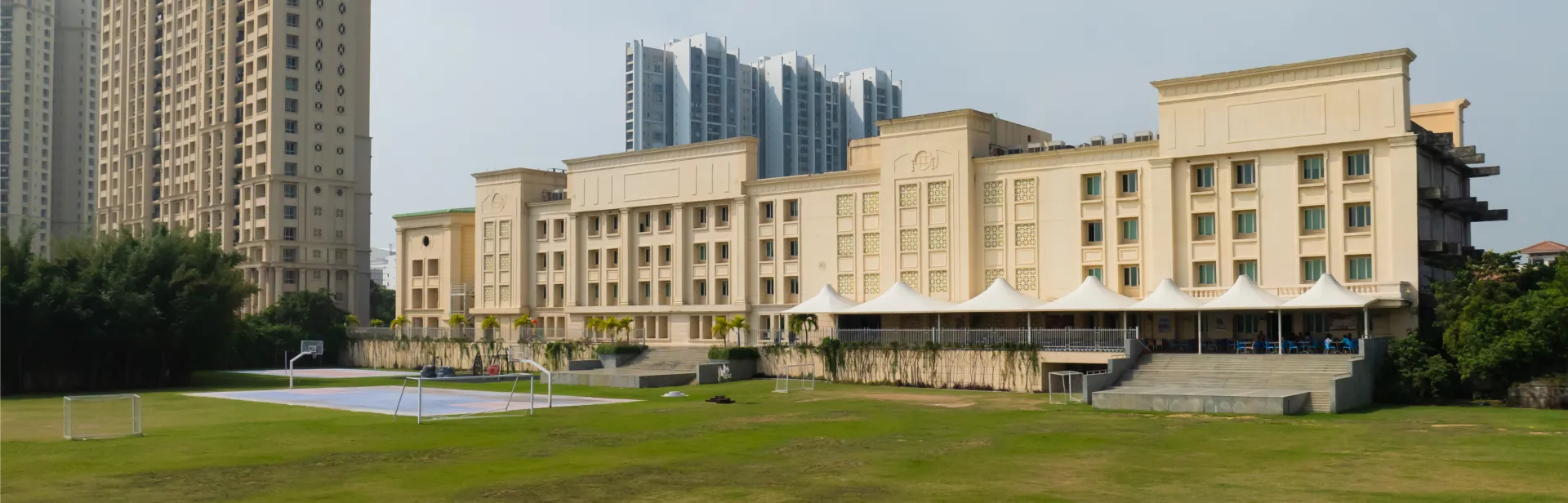
Hiranandani Upscale School (HUS), located in Padur on OMR, offers all four IB programmes on a single campus, providing a seamless learning journey from early childhood through graduation.
How HUS Prepares Students for IB Success
Hiranandani Upscale School (HUS) provides the complete IB continuum for students aged 2 to 18 years, helping them build the skills needed for long-term academic success.
HUS at a Glance
- 5,000+ students educated
- 9+ nationalities represented on campus
- 98% student placement outcomes
- Full IB continuum from EYP through DP
Student-Centric Learning Environment
Class sizes are intentionally kept small:
- 20 students per class in EYP and PYP
- 25 students per class in MYP and DP
This allows for greater individual attention and personalised learning support.
Facilities That Support Learning
Students benefit from:
- Modern science laboratories
- Performing arts studios
- Well-equipped library facilities
- Inquiry-based learning spaces
For families considering IB school admission in Chennai, HUS's continuum approach ensures students enter the Diploma Programme with years of experience in inquiry, research, collaboration, and reflective learning.
FAQ's
The IB Diploma Programme is graded out of 45 points in total. Six subjects are scored on a 1 to 7 scale, contributing up to 42 points, and the Theory of Knowledge and Extended Essay core components add up to 3 bonus points through a combined matrix. Creativity, Activity, Service (CAS) is required but ungraded.
A student must score at least 24 points across the six subjects to pass the IB Diploma Programme, alongside satisfying all CAS requirements and meeting specific subject-level conditions. These conditions include minimum grades at Higher and Standard Level, no failing conditions in TOK or the Extended Essay, and completion of all internal and external assessments.
Yes, an IB score of 40 out of 45 is considered an excellent result globally. It places a student well above the global average of approximately 30 to 31 points and is competitive for admission to highly selective universities across the UK, US, Canada, Australia, Europe, and India. Strong subject-level grades alongside the total score further strengthen university applications.
The PYP curriculum builds inquiry-based learning, conceptual understanding, and self-management skills from age 6 to 11. Students develop research habits, collaborative thinking, and reflective practice — all foundational to the Middle Years Programme and the Diploma Programme. This early grounding is why IB continuum schools tend to support stronger long-term outcomes in the IB scoring system.
Families can apply for IB school admission Chennai at Hiranandani Upscale School by submitting an online application through hus.edu.in. The process includes document submission, a campus interaction and visit, followed by confirmation and enrollment. Admissions are open for the 2026–27 academic year across EYP, PYP, MYP, and DP. Contact admissions@huschennai.in for guidance.