IB HL vs SL Subjects: How to Choose the Right Level for Your Goals

June 17, 2026
Table of contents
Choosing your six IB curriculum subjects is the first big decision of the IB Diploma Programme. Within hours of picking them, you face the next one: which three will you take at Higher Level and which three at Standard Level? The HL vs SL choice shapes your workload, your final score, and what you can study at university. Get it right early, and the next two years feel built around your strengths. Get it wrong, and you spend the diploma fighting your own timetable.
This guide walks through what HL and SL in IB actually mean, where they differ, and the framework we use at HUS Chennai to help students decide. The aim is to give you a clear, evidence-based way to choose, not a vague "pick what you love" answer.
What Are HL and SL in the IB Diploma Programme?
Every IBDP student takes six subjects, one from each of the six groups (or two from groups three or four in place of group six). Three of those subjects must be at Higher Level (HL), and three at Standard Level (SL). Some students take four HL subjects, but that is the exception, not the rule.
Both levels use the same 1 to 7 grading scale. Both contribute equally to your subject score. The difference lies in depth, hours and assessment demand. This is the foundation every other HL vs SL decision builds on.
| Feature | Higher Level (HL) | Standard Level (SL) |
|---|---|---|
| Teaching Hours | 240 hours per subject | 150 hours per subject |
| Depth of Content | Greater depth, additional topics and options | Core content only, less detail |
| Assessment | More papers, longer durations, and often a third paper | Fewer papers, shorter durations |
| Internal Assessment | Usually carries a lower percentage of the final grade | Often carries a higher percentage of the final grade |
| University Recognition | Often required for related degrees | Accepted as supporting subjects |
| Workload Intensity | High, comparable to first-year university content | Moderate, challenging but manageable |
Why the HL vs SL Choice Matters So Much for Your IB Diploma
Two students with the exact same subjects can finish the diploma with very different scores depending on how they distribute HL and SL. The choice has three big consequences.
1. It Decides Where Your Energy Goes
HL subjects demand roughly 60% more teaching hours than SL. That extra time has to come from somewhere, usually from independent study and revision. Pick three HL subjects that need constant attention, and your CAS, EE and TOK work suffers.
2. It Affects Your University Options
Most competitive university courses publish their HL requirements before they list anything else. Medicine in the UK typically demands HL Biology and Chemistry. Engineering programmes usually want HL Mathematics and HL Physics. Business courses at top schools often list HL Mathematics or HL Economics. If your dream course requires HL Chemistry and you take it at SL, you may not even qualify to apply.
3. It Influences Your Total IB Score
To earn the diploma, you need at least 12 of 21 points across your HL subjects and at least 9 of 21 across your SL subjects. A student who overreaches on HL choices and scores 3s loses far more than a student who took the same subjects at SL and scored 5s. Total points still matter for the IB Diploma, and overreach is the most common reason students miss the 24-point pass threshold.
Five Questions to Ask Before Choosing HL or SL Subjects
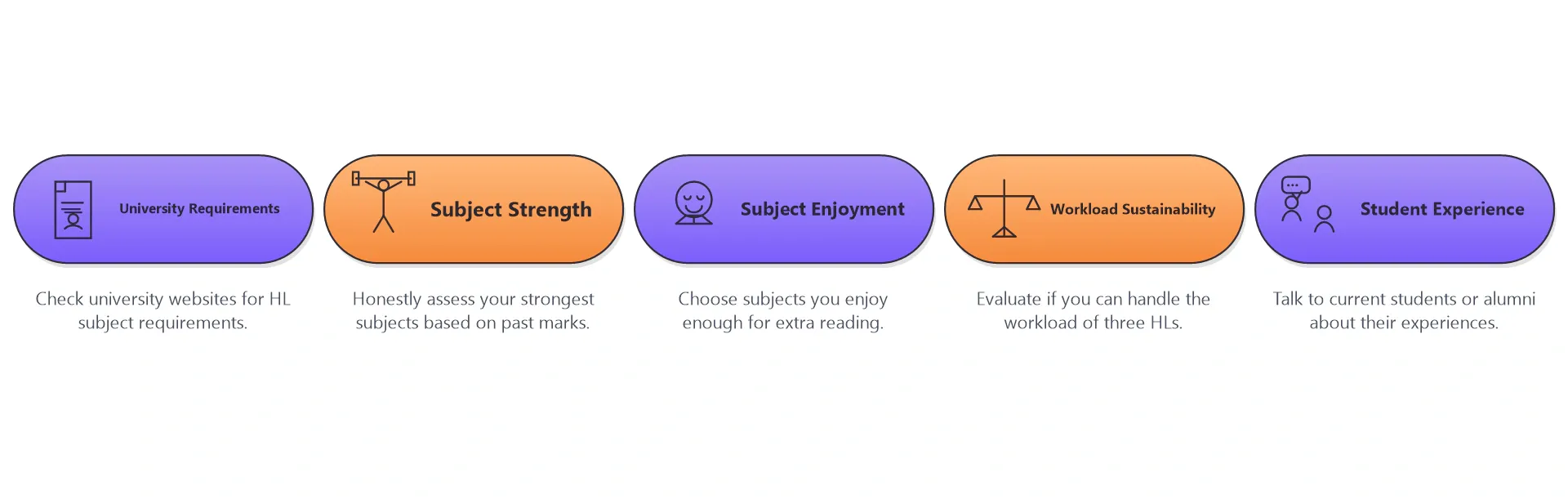
At HUS, when students come to us conflicted about HL and SL in IB, we walk them through five questions in this order. Working through them honestly takes about 30 minutes and saves two years of frustration.
Also Read- Excellence Through Endeavour: The IB Experience at HUS
IB Mathematics: HL vs SL, AA vs AI, How to Choose
Mathematics is the subject where the HL vs SL choice most often goes wrong, and the cost is high. The IB offers two different maths courses (AA and AI), each available at HL and SL. That gives you four options to pick from. Here is the cleanest way to think about it.
| Course and Level | Best For | Typical University Match |
|---|---|---|
| Mathematics AA HL | Students strong in theory and who enjoy algebraic proof | Engineering, Physics, Computer Science, Quant Economics at top universities |
| Mathematics AA SL | Students who need a solid theoretical maths base but not a specialism | Life Sciences, Medicine, most Business and Social Sciences |
| Mathematics AI HL | Students who excel at applied, real-world maths and statistics | Finance, Data Science, Psychology, some Business and Social Sciences |
| Mathematics AI SL | Students aiming at non-quantitative degrees | Humanities, Arts, Design, Law |
Quick rule of thumb: if you have any doubt and you are aiming at a top-tier STEM or Economics course, Mathematics AA HL is the most universally accepted prerequisite. Pick AI only when you have confirmed your target universities accept it for your chosen field.
Best IB HL Subject Combinations by University Pathway
Here are five common IB HL combinations students at HUS Chennai choose, mapped to typical university pathways.
| Combination (HL Subjects) | Best Suited For |
|---|---|
| Maths AA, Physics, Chemistry | Engineering, Computer Science, Physical Sciences |
| Biology, Chemistry, English | Medicine, Biomedical Sciences, Pharmacy, Dentistry |
| Economics, Business, Maths AA | Business, Finance, Economics, Management |
| English, History, Economics | Law, International Relations, Politics, Social Sciences |
| Visual Arts, English, Psychology | Design, Architecture, Creative Industries, Psychology |
Common Mistakes IB Students Make with the HL vs SL Choice
Across years of advising IBDP students at HUS, we see the same avoidable errors. Watch for these.
- Picking HL because friends are. Your timetable is not theirs. Their reading speed, prior knowledge and ambitions are not yours either.
- Choosing HL Mathematics AA when AI fits the career path better. AA is for theoretical maths, AI for applied work. Picking the wrong one wastes hours on the wrong skill set.
- Taking four HLs without a strong reason. Four HLs only make sense if every one of them is a university requirement, you have a track record of strength in all four, and you accept that EE, CAS and TOK will eat into rest time.
- Avoiding a subject at HL just because it has a reputation for being hard. Reputation is not data. Look at your school's actual results in that subject.
- Switching levels late. The IB allows level changes only within a narrow early window. Decide carefully at the start of DP1.
How HL vs SL Affects Your Final IB Diploma Score
The maximum diploma score is 45. That breaks down as 42 from six subjects (HL and SL count equally at 7 points each) and up to 3 bonus points from the EE and Theory of Knowledge matrix. To pass, you need at least 24 points and to meet specific HL and SL thresholds.
The threshold rules are worth memorising:
- At least 12 points combined across your three HL subjects.
- At least 9 points combined across your three SL subjects (if you take four HLs and two SLs, then at least 5 combined across two SLs).
- No HL grade below 2.
- No more than two SL grades at 3 or below.
- A pass in TOK, EE and CAS.
This is exactly why a measured HL choice matters. A solid 5 at HL contributes more to your diploma than a stretched 3 ever will.
How HUS Chennai Supports the HL vs SL Choice
At Hiranandani Upscale School, the HL and SL selection process begins in Grade 10, giving students ample time to explore their options before entering the IB Diploma Programme.
MYP5 students are introduced to university destinations and admission requirements in Grade 10. During Term 2, students participate in dedicated subject-selection sessions that explain the structure of the DP, the subject groups offered at HUS, and the factors to consider when choosing HL and SL subjects. These sessions are conducted in collaboration with the Career Counsellor and DP Coordinator.
Parents are also involved through dedicated orientation sessions, followed by one-on-one meetings with the Career Counsellor to discuss individual academic goals, university aspirations, and subject combinations.
To help students make informed decisions, HUS offers a 15-day window at the start of DP1, allowing students to experience the rigor and expectations of their chosen subjects before finalising their selections. This structured and student-centric approach ensures that subject choices align with both student strengths and future university pathways.
Also Read: Benefits of the IB Program: What Opportunities Await
Conclusion
The HL vs SL decision is not about courage or ambition. It is about fit. The right combination for you is the one that opens your target university doors, plays to your real strengths, and leaves you energy for the rest of life. Start with your university requirements, audit your strengths honestly, and use your school's data, not corridor advice. For more on what each subject looks like at each level, our guide to subjects for IB breaks down every option across the six IBDP groups.
References
FAQ's
HL stands for Higher Level, and SL stands for Standard Level. Every IB Diploma student takes six subjects, usually three at HL and three at SL. HL subjects require 240 teaching hours and cover more depth, while SL subjects require 150 hours and cover the core content. Both use the same 1 to 7 grading scale.
HL covers more content, demands more teaching hours, and assesses with additional papers, so it is more rigorous than SL. However, both use the same 1 to 7 grading scale and the same Internal Assessment weighting. With the right preparation and interest, students can score well at either level.
It depends entirely on the course. Medicine usually requires HL Biology and Chemistry, engineering needs HL Mathematics AA and Physics, law programmes look for HL English or History, and business courses often want HL Mathematics or Economics. Always check the exact entry requirements of your target universities.
Yes, but only within a short window in the first few months of DP1. After that, the curriculum diverges, and level changes become very difficult. This is why a thoughtful HL vs SL choice early in Grade 11 matters so much.
Only if a university course genuinely requires four HLs, you have a track record of strong results in all four, and you can manage CAS, EE and TOK alongside the extra workload. For most students, three HL subjects done well will outperform four HL subjects done thinly.