What is IBDP? How the Diploma Programme Works

August 9, 2026
Table Of Contents
What Does "IB" Mean, and How Is It Different from the Diploma Programme?
The IB is the organisation behind four programmes: the Early Years (EYP), Primary Years (PYP), Middle Years (MYP), and the Diploma stage for Grades 11-12. The Diploma course is simply the short form students, parents and schools use for this final, university-facing stage. If a learner has come up through the earlier years, this stage is the natural next step; if you are exploring the wider IB system from scratch, this guide to what the IB programme covers walks through all four stages first.
What is the IBDP or IB Diploma?
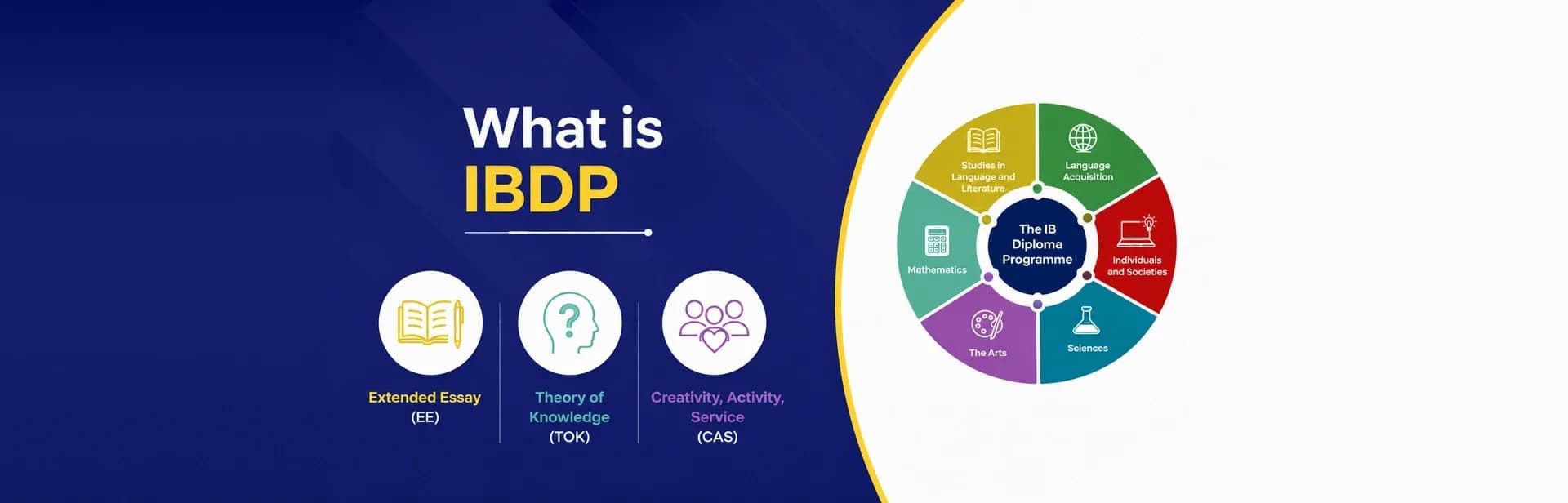
IBDP stands for the International Baccalaureate Diploma Programme, a two-year pre-university course for students aged 16 to 19 (Grades 11 and 12). Set up by the IB in Geneva in 1968, it is now taught in more than 5,500 schools across over 150 countries and is recognised by leading universities worldwide, including in India. Students take six subjects alongside a compulsory three-part core, and are graded out of 45 points.
| Duration | 2 years (Grades 11-12) |
| Age group | 16 to 19 years |
| Subjects | 6, plus a 3-part core |
| Maximum score | 45 points (24 to pass) |
| Recognised in | 150+ countries, incl. India (AIU-equivalent to Class 12) |
| Assessment | Internal (teacher-graded) + external exams |
What Is the Subject Structure of the IB Diploma Program?
Every student picks one subject from each of six groups, three at Higher Level (HL, roughly 240 teaching hours) and three at Standard Level (SL, roughly 150 hours). The six groups are:
Group 1 - Studies in Language and Literature
The student's best language, studied through literary and non-literary texts.
Group 2 - Language Acquisition
A second (or third) language, from beginner Ab Initio courses to advanced Language B.
Group 3 - Individuals and Societies
Humanities and social sciences such as Economics, History, Psychology, Business Management or Global Politics.
Group 4 - Sciences
Biology, Chemistry, Physics, Computer Science or Environmental Systems and Societies.
Group 5 - Mathematics
Either Analysis and Approaches (proof-heavy, suited to engineering and pure sciences) or Applications and Interpretation (modelling and statistics-led).
Group 6 - The Arts
Visual Art, Music or Theatre, or students can instead take a second subject from Groups 1 to 4. For a subject-by-subject breakdown of what each group actually involves at HL and SL, see this detailed guide to subject choices.
How Is the International Baccalaureate Diploma Graded?

Each of the six subjects is scored from 1 to 7 (a 7 being roughly equivalent to an A*), giving a maximum of 42 points. Up to 3 additional points come from combined TOK and EE performance, for a total ceiling of 45. A minimum of 24 points is generally required to earn the diploma, along with passing conditions in TOK, the EE and CAS. Grading blends internally assessed coursework, moderated by IB examiners, with externally set final exams sat in November or May.
| Component | Points available |
| Six subjects (1-7 each) | 42 |
| TOK + Extended Essay bonus | 3 |
| Total ceiling | 45 |
| Typical pass threshold | 24 |
Is It Recognised in India and by Global Universities?
Yes. The Association of Indian Universities (AIU) treats the diploma as equivalent to the All India Senior School Certificate (Class 12), so graduates can apply to Indian universities on the same footing as CBSE or state-board students, in addition to over 90 countries' university systems abroad, including the Ivy League, Oxbridge, and Indian institutions that run direct IB-entry pathways. Universities consistently note that graduates arrive better prepared for independent research and long-form writing, largely thanks to the EE and TOK.
How Does the IB Diploma Program Compare to CBSE or A-Levels?
| Components | This Programme | CBSE | A-Levels |
| Focus | Broad, inquiry-based, 6 subjects | Structured, exam-focused | Deep, 3-4 subjects |
| Core requirement | TOK, EE, CAS | None | None |
| Grading | Out of 45 | Percentage/CGPA | Grade per subject |
| Best suited to | Breadth + independent research | Structured exam prep, JEE/NEET aligned | Early specialisation |
Who Tends to Do Well in This Course?
It rewards curiosity and time-management over rote memorisation, so it tends to suit students who enjoy writing, research and juggling several subjects rather than narrowing early into two or three. It is a demanding two years; students weighing HL/SL combinations often find it useful to read this HL vs SL subject-selection guide before finalising choices, and this step-by-step guide to earning the diploma for a week-by-week sense of the workload.
How Assessments Work in the IB Diploma Programme
The IB Diploma Programme uses a mix of internal and external assessments instead of relying only on final exams.
- External assessments include written exams at the end of the programme, which are marked by IB examiners.
- Internal assessments are projects, investigations, presentations, or oral tasks completed during the course and assessed by teachers, with moderation by the IB.
Students are also evaluated through the Extended Essay (EE), Theory of Knowledge (TOK), and Creativity, Activity, Service (CAS), which help develop research, critical thinking, and personal growth.
IB Diploma At Hiranandani Upscale School
The best way to understand the IB Diploma Programme is to experience it firsthand, whether it's a Theory of Knowledge discussion, a science lab, or a classroom session. A campus visit can help you see how the programme supports your child's academic and personal growth.
Choosing between boards or planning subject combinations gets easier once you have seen the programme in action. At Hiranandani Upscale School, students move into the IB Diploma Programme after completing the MYP, with full university counselling support built into the final two years. Book a campus visit to see how HUS structures this stage for its Grade 11-12 students, or start the admission process directly.
References
· https://ibo.org/programmes/diploma-programme/
· https://ibo.org/programmes/diploma-programme/curriculum/dp-core/
FAQ's
It stands for the International Baccalaureate Diploma Programme, the two-year pre-university course offered to students in Grades 11 and 12.
No. The IB is the umbrella organisation running four programmes; the Diploma stage is specifically its final, two-year phase for ages 16 to 19.
Six subjects, three at Higher Level and three at Standard Level, plus the three-part core (TOK, EE, CAS).
24 out of 45 is the usual minimum to pass, 30+ is considered strong, and 40+ is typically needed for the most selective global universities.
Yes. The AIU treats it as equivalent to Class 12, and it is also accepted by universities in over 90 countries.
It is broader rather than simply "harder": CBSE concentrates on exam performance across more subjects, A-Levels go deep on 3-4 subjects, while this course adds independent research (EE) and reflective learning (TOK, CAS) on top of six subjects.