What Is STEM Education? Full Form, Benefits and IB Role

November 25, 2026
Table of Contents
STEM stands for Science, Technology, Engineering and Mathematics. STEM education teaches these four subjects as connected parts of one way of thinking, usually through hands-on projects built around real problems. Instead of memorising a formula for a test, a child uses it to design, build and check something that works.
This guide covers the STEM full form and its origin, the benefits, how STEM differs from STEAM, how the IB teaches it from age 3 to 19, and what India's education policy says about it.
What Is the STEM Full Form, and Where Did the Term Come From?
The STEM full form is Science, Technology, Engineering and Mathematics. The acronym was coined at the US National Science Foundation around 2001, when Judith Ramaley, then an NSF education director, suggested reordering the older label "SMET" into "STEM". The new name stuck, partly because it was easier to say and partly because it suggested a stem from which other learning grows.
Real problems do not arrive sorted by subject. Designing a water filter needs chemistry, measurement and some maths to compare results. Good STEM teaching treats that overlap as the starting point.
What Does STEM Education Look Like in a Classroom?
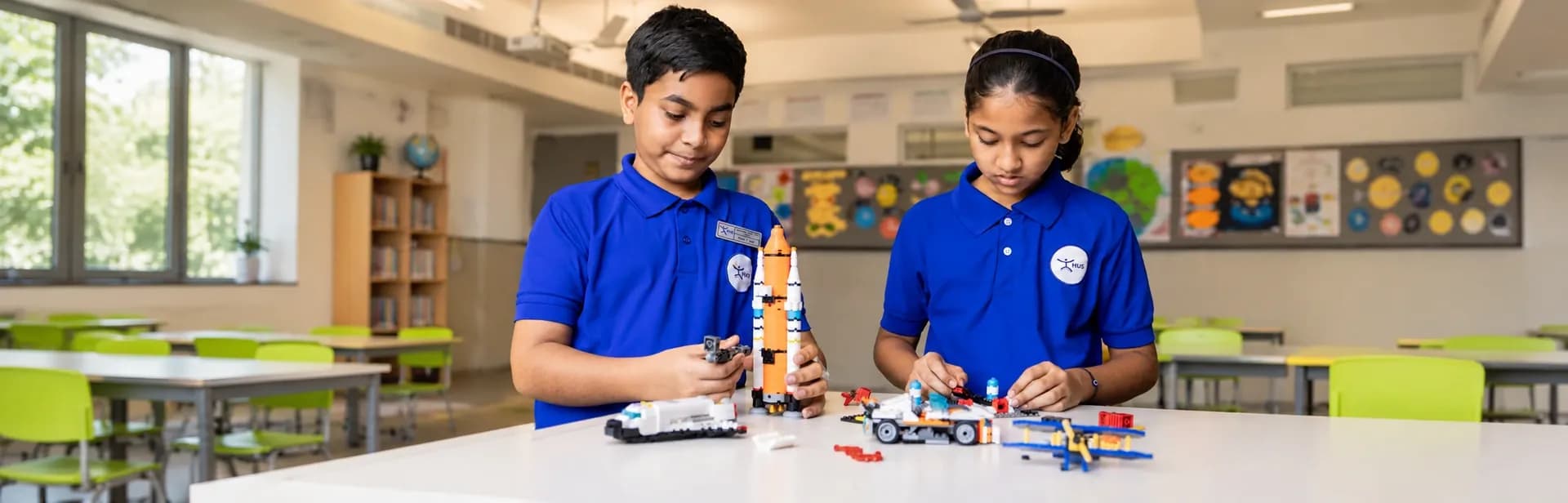
Picture two Grade 4 lessons on forces. In the first, children copy a definition and label a diagram. In the second, they get paper, tape and a cup of coins, and are asked to build a bridge that holds the most weight. When it sags, they strengthen the joints, test again and record the load each time.
Both lessons cover forces. Only the second asks children to plan, measure, fail, adjust and explain why the stronger design worked. That bridge challenge is a real example from our IB Primary Years Programme, showing the core of STEM: concepts learnt by using them.
Why Is STEM Education Important for Your Child?
The importance of STEM education goes well beyond producing engineers. Most of what a child gains is a set of thinking habits that carry into any career:
- Problem solving: children learn to break a big, messy problem into steps they can test.
- Evidence over guesswork: measuring results teaches them to trust data rather than hunches.
- Resilience: a prototype that fails is normal, so setbacks stop feeling like the end.
- Collaboration: most STEM tasks are team tasks, with roles, deadlines and disagreements to sort out.
- Digital confidence: coding and computational thinking make technology something they build, not only use.
- Wider choices later: strong maths and science keep doors open to medicine, engineering, data, design and economics.
That last point matters for Indian families. A child who drops maths or science too early narrows options before knowing what they want. This is the real importance of STEM education: keeping those subjects enjoyable long enough for interests to show up.
What Is the Difference Between STEM and STEAM?
STEAM adds the Arts to STEM. Here is how they compare.
Neither is better, and many IB schools blend the two.
| STEM | STEAM | |
| Subjects | Science, Technology, Engineering, Maths | STEM plus visual art, design, music, writing |
| Main focus | Analysis, testing, building solutions | Solutions that are also creative and human-centred |
| Typical project | Build a solar-powered fan and measure airflow | Build the fan, then design its look and a pitch for users |
| Best for | Strengthening logic and technical depth | Linking technical skill with creativity and communication |
How Is STEM Taught in the IB Curriculum?
There is no separate "STEM subject" in the IB. Instead, STEM in IB curriculum planning runs through all three programmes, growing deeper at each stage.
| Programme | Ages | How STEM Shows Up |
| PYP | 3 to 12 | Transdisciplinary inquiry units; science and maths learnt through real questions and the Grade 5 Exhibition |
| MYP | 11 to 16 | Sciences, Mathematics and Design as subject groups; interdisciplinary units; the Personal Project |
| DP | 16 to 19 | At least one Group 4 science, one Group 5 maths course, a collaborative sciences project and the Extended Essay |
The IB describes STEM in the MYP as an important perspective, delivered through interdisciplinary units and long projects rather than as a bolt-on. In the IB Diploma Programme, Group 4 includes biology, chemistry, physics, computer science, design technology and sports, exercise and health science, and every student takes one maths course: analysis and approaches or applications and interpretation. Our guide to choosing IB DP subjects and our explainer on IB HL vs SL levels help families plan a STEM-heavy combination. Parents often ask whether STEM in IB curriculum terms still allows a student to sit for JEE or NEET; the answer is yes, with the right subject choices.
How Is India Supporting STEM Education?
India's National Education Policy 2020 calls for experiential, hands-on learning at every stage and for coding to be introduced in the middle stage, Grades 6 to 8. Computational thinking is meant to start even earlier, alongside mathematics.
The Atal Innovation Mission has set up around 10,000 Atal Tinkering Labs in schools, with more than half in rural areas, and the 2025 Union Budget announced 50,000 more for government schools over five years. STEM learning in India is no longer a private-school extra. It is national policy.
How Can Parents Spot and Support Good STEM Learning?
When you visit a school, ask to see student work, not just the lab. Look for prototypes, data tables and written reflections, and ask how often children design their own investigations. A well-equipped room used twice a term matters less than regular, messy, hands-on lessons. At HUS, labs and a computer room support weekly practical work across year groups.
At home, cook together and talk about measurements, take apart an old gadget, or ask "how could we test that?" These habits build the curiosity STEM lessons depend on, and show how technology prepares students for future careers.
FAQ's
STEM stands for Science, Technology, Engineering and Mathematics. The term was first used at the US National Science Foundation around 2001.
It is a way of teaching science, technology, engineering and maths together through hands-on projects, so children apply what they learn to solve real problems.
As early as preschool, through play: building blocks, sorting, measuring water and asking "what happens if?" Formal coding usually begins around Grades 6 to 8.
Yes. STEM runs through the PYP's inquiry units, the MYP's sciences, maths and design groups, and the DP's Group 4 sciences, Group 5 maths and Extended Essay.
Early, confident exposure to maths and science keeps future options open. Hands-on, team-based STEM lessons also help girls see these subjects as creative and collaborative.
STEM education is less about turning every child into a scientist and more about raising children who can question, test and build. At Hiranandani Upscale School on OMR, Chennai, that thinking starts with play in the early years and grows into independent research by the Diploma years. Read how the Extended Essay brings it all together, or start your child's journey through our IB admissions process.